How long does a water heater last, and how to tell yours is failing
A tank water heater in Oregon lasts eight to twelve years. Tankless runs fifteen to twenty. Most tanks give six to twelve months of warning before they fail, and almost nobody notices — which is how a $1,400 planned replacement becomes a $6,000 flooded-utility-room afternoon.
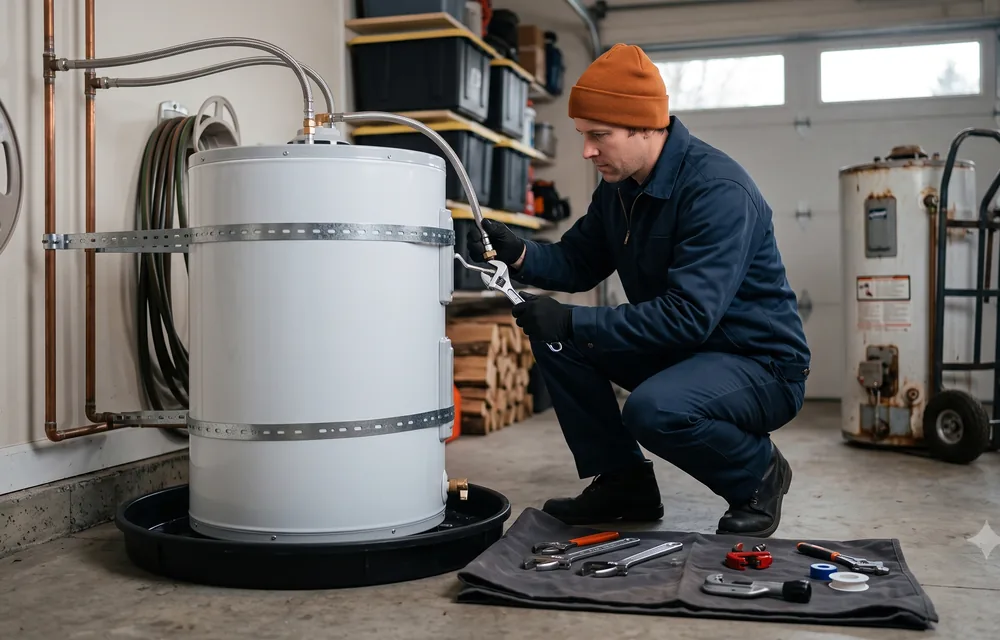
The actual numbers, and what changes them
A conventional glass-lined steel tank has a design life of eight to twelve years. A tankless unit runs fifteen to twenty, and a well-maintained one can exceed that. Those are the manufacturer figures and they are roughly honest, but the spread within them is enormous and it is driven by four things.
Water hardness. This is the biggest single factor and it varies wildly across Oregon. Portland and much of the west side draw exceptionally soft water from the Bull Run watershed — that water is kind to a tank. Central and Southern Oregon are a different story: Bend, Redmond, Prineville, Klamath Falls and many well-supplied properties across the state run genuinely hard water, and hardness deposits calcium scale on the bottom of the tank and on the heating surfaces. Scale insulates the burner from the water, which forces longer burn cycles, which stresses the steel and the glass lining. A tank in Bend that is never flushed can fail years earlier than the same tank in Portland.
The anode rod. Every tank contains a sacrificial magnesium or aluminium rod that corrodes preferentially so the steel does not. It is a consumable. When it is gone, the tank begins to rust from the inside, and the clock runs fast from that point. A rod typically lasts three to five years, faster in soft water and faster still with a water softener, and replacing it is a $40 part and an hour of work that can add years to the tank. Almost nobody does it.
Sediment. Mineral solids settle to the bottom of the tank and form a layer that traps heat against the steel. On a gas unit, that is the mechanism behind the popping and rumbling sound that everyone recognises and few people act on. Annual flushing removes it. Very few Oregon tanks are ever flushed.
Temperature setting. Higher settings accelerate scale formation and metal fatigue. 120°F is the standard recommendation, is adequate for household use, and is also a scald-safety setting. Anything above 140°F noticeably shortens tank life.
The eight signs your water heater is failing
1. Age past ten years. This is not a symptom, it is a probability. Find the serial number on the rating plate — most manufacturers encode the manufacturing date in the first four characters, typically as month and year or week and year. If the unit is past ten and shows any other sign on this list, you are managing a replacement, not a repair.
2. Rusty or discoloured hot water. Run the hot tap and then the cold. If only the hot is brown or has a metallic taste, the corrosion is inside your tank — the anode is spent and the steel is going. If both are discoloured, the problem is your supply or your service line and the tank is innocent. This one test separates a $40 problem from a $1,400 one.
3. Popping, rumbling or banging during heating. Sediment on the tank floor traps water underneath it; that water boils and forces its way through the layer, and the noise is steam escaping. It means the tank is running hotter than it should on the bottom, which is exactly what cracks a glass lining. Flushing may fix it if you act early. Once the noise is loud and constant, the sediment layer is usually hardened and flushing will not clear it.
4. Any moisture around the base. A tank does not weep and then recover. Slight dampness at the base of a ten-year-old tank is a hairline fracture in the steel, and it is the single most reliable predictor of an imminent full failure. Check the fittings and the temperature-and-pressure relief line first, because those are repairable. If the water is coming from the tank itself, replace it now, on your schedule, before it chooses its own.
5. Not enough hot water, or it runs out faster than it used to. Sediment displaces volume. A 50-gallon tank with four inches of sediment is a 40-gallon tank. If nothing about your household has changed but the showers got shorter, that is what happened. On an electric unit it can also be a failed lower heating element, which is a genuinely cheap repair.
6. Water that is not hot enough at all. A thermostat or a heating element, usually. On gas, a failed thermocouple or a fouled burner. All of these are inexpensive parts and worth repairing on a tank under eight years old.
7. Rotten-egg smell from hot taps only. Sulfate-reducing bacteria in the tank reacting with the magnesium anode. Common on Oregon well water. Flush, pasteurise, and swap the magnesium rod for an aluminium-zinc rod — roughly $40. Do not remove the anode entirely; that stops the smell and rots the tank.
8. The relief valve is discharging. The temperature-and-pressure relief valve is the safety device that prevents a tank from becoming a projectile. If it is dripping or venting, either the valve has failed or the tank is genuinely over-pressure or over-temperature. Never cap or plug a T&P valve under any circumstances. This is a same-day call.
Repair or replace: the honest decision
| Situation | Verdict | Typical Oregon cost |
|---|---|---|
| Under 8 years, thermostat or element failure | Repair | $185–$450 |
| Under 8 years, thermocouple or gas valve | Repair | $185–$550 |
| Under 8 years, sediment noise | Flush, then repair if needed | $150–$250 |
| Any age, rotten-egg smell only | Anode rod swap | $150–$300 |
| 8–10 years, any major component failure | Judgement call — usually replace | — |
| Over 10 years, any major component failure | Replace | $1,200–$2,800 tank |
| Any age, leaking from the tank body | Replace immediately | $1,200–$2,800 tank |
| Rusty hot water only | Replace | $1,200–$2,800 tank |
| Replacing with tankless | Depends on gas line and venting | $3,200–$6,500 |
The rule that survives contact with reality: repair anything under eight years old, replace anything over ten, and think hard in between. In the middle band the question is what the repair costs relative to the replacement and how much life the tank plausibly has left. Spending $550 on a gas valve for a nine-year-old tank in hard water is usually money you will spend again inside two years.
And a leaking tank is not a decision at all. Glass-lined steel does not heal. Once the lining has cracked and the steel is wet, the failure sequence is running and the only question is whether it finishes while you are home.
Tankless: when it is actually worth it in Oregon
Tankless is not automatically the better answer, and the economics are more marginal than the marketing suggests.
What tankless genuinely gives you: endless hot water, no standby loss, a footprint the size of a carry-on suitcase, and fifteen to twenty years of life instead of eight to twelve.
What it actually costs: $3,200 to $6,500 installed, against $1,200 to $2,800 for a like-for-like tank. The gap is rarely the unit itself. It is that a tankless unit fires at 150,000 to 199,000 BTU where a tank fires at 40,000, so the existing half-inch gas line frequently has to be upsized, and the venting is completely different — sealed stainless or PVC, not the existing B-vent. On an older Oregon house those two items can add $1,500 on their own.
Where the payback works: high hot-water households, homes that run out of hot water regularly, houses where the tank sits in valuable floor space, and — importantly — anywhere you plan to stay more than about a decade. Standby loss savings run roughly $80 to $200 a year depending on your rate and your usage, so at a $2,500 premium the simple payback is somewhere between twelve and thirty years. That is not a great return on energy savings alone; the case for tankless is capacity, longevity and space, with the energy saving as a bonus.
Where it does not work: hard water without treatment. A tankless heat exchanger scales far more aggressively than a tank because the water passes through narrow passages at high temperature. In Bend, Redmond, Prineville, Klamath Falls or on hard well water, a tankless unit needs annual descaling and realistically wants a softener or a scale inhibitor ahead of it. Skipping that is how a twenty-year unit becomes an eight-year unit.
Our water heater sizing and tankless payback calculator runs the actual numbers for your household — flow rate, groundwater temperature rise for your part of Oregon, and the honest payback period including the gas and venting work.
What actually extends the life of a tank
Flush it annually
Connect a hose to the drain valve, shut off the gas or breaker, close the cold inlet, open a hot tap somewhere in the house, and drain until the water runs clear. Twenty minutes. In hard-water parts of Oregon do it twice a year. This single habit does more for tank life than everything else combined.
Check the anode rod at year three, and every two years after
It unthreads from the top of the tank. If it is heavily pitted or reduced to the bare core wire, replace it — a $40 part. On a tank with a spent anode, the steel is what corrodes next. Note that this is the maintenance item that most often makes the difference between a nine-year tank and a fifteen-year one.
Set the thermostat to 120°F
Adequate for household use, meaningfully slower scale formation, lower standby loss, and a genuine scald-safety benefit if there are children or older adults in the house.
Test the T&P valve once a year
Lift the lever briefly and let it snap back; water should discharge and then stop cleanly. If it does not reseat, or nothing comes out, replace the valve. Stand clear — the discharge is scalding.
Fit an expansion tank if you have a closed system
Most Oregon municipal supplies now have a backflow preventer or check valve at the meter, which makes the plumbing a closed system. Water expands when heated and has nowhere to go, so pressure spikes on every heating cycle. That fatigues the tank and repeatedly lifts the T&P valve. An expansion tank is a few hundred dollars and prevents a failure mode that most homeowners never hear about.
Insulate the first six feet of hot and cold pipe
Cheap foam sleeve, measurable standby saving, and in an unheated Oregon crawlspace it also reduces freeze risk on the cold side.
The failure nobody plans for
When a tank finally goes, it does not drip. The lining cracks, the steel opens, and forty or fifty gallons arrives on the floor at once, followed by mains pressure feeding it until someone closes a valve. If the tank is in a finished basement, a laundry room over a living space, or a garage with an interior door threshold, the damage is a flooring and drywall claim rather than a plumbing bill.
Three things make that outcome much less likely, and none of them are expensive.
Know where the shutoff is. There is a cold-water valve on the inlet at the top of the tank, and there is the main for the house. Find both, today, and make sure the household knows. A stiff gate valve that has not moved in fifteen years is worth replacing with a quarter-turn ball valve while you are down there.
Fit a drain pan with a piped drain. Required by code in many situations and a good idea in all of them. A pan alone helps; a pan piped to a floor drain or outside turns a catastrophe into a puddle.
Put a $15 leak alarm in the pan. A battery water sensor that shrieks when it gets wet. For fifteen dollars it converts the most expensive residential plumbing failure into an inconvenience, and it is the single best value item in this entire guide.
If your tank is past ten and showing any sign on the list above, the sensible move is a planned replacement on a weekday at standard rates. Our water heater repair and replacement page covers what that involves, including the permit and inspection — water heater replacement is permitted work in Oregon, and unpermitted work reliably resurfaces during a future property sale at considerably greater cost.
Frequently asked questions
How do I find out how old my water heater is?
The serial number on the rating plate encodes it. Most manufacturers put the date in the first four characters — commonly a two-digit month or week followed by a two-digit year, so 0517 usually means May 2017 or week 5 of 2017. Rheem, AO Smith, Bradford White and State each use slightly different schemes, and searching the brand plus "serial number date code" gives you the key. If the plate is unreadable, the installation permit record with your local building department will have it.
Is it worth repairing a 10-year-old water heater?
Usually not, if the repair is a major component. A thermostat or element on an electric unit is cheap enough to be worth it even late in life. A gas valve, a burner assembly or anything involving the tank itself is money spent on an asset with little life left, particularly in hard-water parts of Oregon. Any leak from the tank body is not a repair question at all — glass-lined steel does not recover.
Why does my water heater make a popping noise?
Sediment on the bottom of the tank traps water underneath it. That water flashes to steam and forces its way up through the layer, and the popping is what you hear. It means the tank floor is running hotter than designed, which is what cracks the glass lining. Flushing may clear it if you act early; once the layer has hardened, flushing generally will not, and the noise is a countdown rather than a nuisance.
How much does water heater replacement cost in Oregon?
A like-for-like tank replacement typically runs $1,200 to $2,800 including removal and disposal of the old unit, and the range is driven mostly by capacity, fuel type, whether the venting or gas line needs work, and access. Tankless conversion runs $3,200 to $6,500, with most of the premium going to gas line upsizing and new venting rather than the appliance. Both are permitted work, and the permit and inspection should be in the quote.
Should I switch to tankless?
If you routinely run out of hot water, want the floor space, plan to stay more than a decade, and either have soft water or are willing to descale annually — yes. If you are simply replacing a working-enough tank on soft Portland water and expecting the energy saving to pay for it, the arithmetic is weak: standby savings of $80 to $200 a year against a premium of $2,000 or more. Run your own numbers in our sizing and payback calculator rather than taking anyone's word for it.
Services mentioned in this guide
Water Heater Repair & Replacement
Most water heater calls split cleanly into two groups: a $200 part on a tank worth keeping, and a tank that has already failed and is quietly ruining the floor.
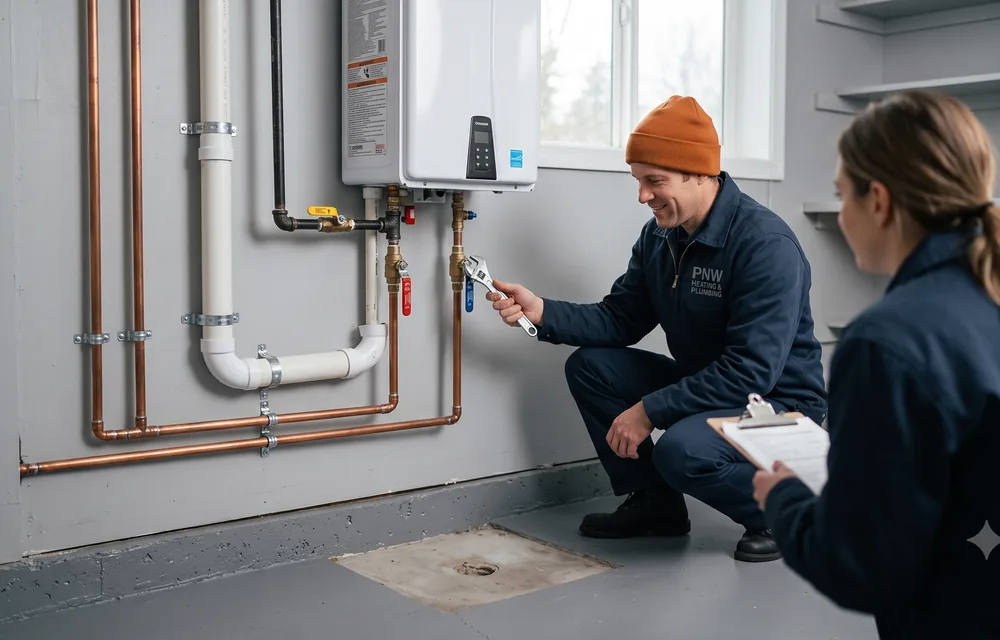
Tankless Water Heater Installation
Tankless is a genuinely better appliance for the right house and a frustrating, expensive mistake in the wrong one.
Water Service Line Replacement
The water service line is the pipe carrying potable water from the meter to your house.
More guides
How to Unclog a Drain Yourself (and When to Stop)
Most single-fixture clogs are genuinely a DIY job. Here is what works, in the order a plumber would try it — and the p…
Sewer Backup: What to Do in the First Ten Minutes
A main line backup gets measurably worse with every gallon of water the household uses. What you do in the first ten m…
Winterizing Plumbing in Oregon: A Regional Checklist
Generic winterizing advice is written for the Midwest and it is either overkill or dangerously inadequate depending on…