Septic tank pumping in Oregon: how often, what it costs, and who is allowed to do it
Oregon DEQ says a properly sized septic tank typically holds three to eight years of use before it needs pumping, and recommends pumping once sludge and scum fill more than 35 percent of the tank. Only a pumper holding a DEQ sewage disposal service licence may empty it. We are not a pumping company: our side of a septic property is the pipe between the house and the tank, which is where a surprising share of "the tank must be full" calls actually end.
How often an Oregon septic tank needs pumping
| Household on a 1,000-gallon tank | Rough pumping interval |
|---|---|
| Four people, four-bedroom house | On the order of every 3 years |
| Two people, same system | On the order of every 6 years |
| Tank installed before 1979 | Sooner — these tanks can be smaller |
| Garbage disposal in daily use | Sooner — it adds solids directly to the sludge layer |
There is no single interval. DEQ's guidance is that pumping frequency depends on tank volume, the number of people using the system, and what goes down the drain — a garbage disposal being the example DEQ gives. A properly sized tank "typically" has capacity for three to eight years of use.
The figures above come from DEQ's own worked example, built on the Oregon standard that a 1,000-gallon tank is required for homes with up to four bedrooms. DEQ attributes the frequencies to Oregon State University Extension Service Circular No. 1343.
Notice how much the household size moves it. The tank does not fill on a schedule; it fills at the rate your house loads it, which is why two people can safely run twice as long as four on identical equipment.
The 35 percent rule, and why guessing costs more
DEQ's actual recommendation is not a calendar date. It is to pump when sludge and scum take up more than 35 percent of the tank volume, and to check your tank's manual for how to measure sludge depth.
The reason the measurement matters more than the interval is what happens when the tank stays full. Solids that should settle in the tank stay suspended and carry out into the drainfield. DEQ is blunt about the consequence: the drainfield may not fail immediately, but "continued neglect will result in failure of the drainfield, and will need to be replaced."
That is the asymmetry worth understanding before deciding to skip a year. A pump-out is routine maintenance. A replacement drainfield is an excavation project, and on a constrained lot it can be the most expensive thing that ever happens to the property. Sewage surfacing in the yard also exposes people and animals to disease-causing organisms, which is why this is regulated at all.
Who is allowed to pump a septic tank in Oregon
A pumper holding a DEQ sewage disposal service licence, and nobody else. DEQ states that septic tank pumpers must hold that licence, and that a licence is required before a business may even advertise or represent itself as providing sewage disposal services. Pumping, transporting and disposing of the contents of a septic system is named directly in what the licence covers.
DEQ issues the licence in three forms: installer only, pumper only, and combined pumper/installer. Before hiring, DEQ advises verifying that the licence and bond are current and checking references with prior clients. You can look a business up in DEQ's licence search for installer and pumper businesses, and the requirements themselves are on DEQ's sewage disposal service licensing page.
To be direct about our own position: we do not pump septic tanks. We are a drain and sewer company, and emptying a tank is a different licensed trade with a vacuum truck and a permitted disposal site behind it. What we do on a septic property is everything upstream of the tank, which is covered further down this page.
Many counties administer the onsite septic programme on DEQ's behalf, so your county environmental health office is usually the faster phone call for local rules, records of your system, and which permits apply.
What actually happens during a pump-out
Emptying the tank is not simply sucking out the liquid. DEQ describes the method: the scum layer has to be broken up and the sludge layer stirred back into the liquid, which the operator does by pumping liquid back and forth between the truck and the tank. Only once the sludge is in suspension is the tank emptied.
This is the difference between a thorough pump-out and a cheap one. A truck that removes the liquid and leaves a compacted sludge layer on the bottom has taken your money and reset very little of the tank's working capacity.
DEQ also sets the expectation that a good operator inspects the condition of the tank and its tees or baffles while it is empty, since that is the only time they are visible, and tells the owner if repairs are needed. Those repairs may require a permit through the local DEQ office or the county.
What moves the cost of septic tank pumping
We publish no price for pumping, because it is not our work and we have no Oregon figure from a source worth repeating. Treat any number you find online as a starting point for questions rather than a quote, and get the price confirmed against your own property. These are the factors that actually move it:
- Tank size and how full it is. Volume removed is volume the truck has to haul and pay to dispose of.
- Access. A tank the truck can reach with its hose costs less than one at the far end of a property, behind a gate, or up a slope.
- Whether the lid has to be dug up. If the access lid is buried, somebody has to find and excavate it first. Risers fitted at ground level remove this cost permanently and are worth asking about while the tank is open.
- Distance to an approved disposal site, which is why rural Oregon pricing differs from the valley.
- Condition of the tees and baffles. A pump-out that turns up a failed baffle turns into a repair, and repairs may need a permit.
- Scheduled versus emergency. A planned pump-out is priced calmly; one booked because sewage is backing up on a Sunday is not.
Signs the tank is the problem
On a septic property the whole-house symptoms are the ones that point at the tank or the drainfield rather than at one fixture:
- Everything drains slowly at once, and the lowest fixture in the house backs up first.
- Gurgling from a toilet or a tub when another fixture drains. Our guide on a gurgling toilet covers how to read that sound.
- Soggy ground or unusually green, fast-growing grass over the drainfield. That is effluent surfacing, and it means the field is saturated.
- Sewage odour outdoors near the tank or field.
- Sewage entering the house. Stop using water and treat it as urgent; see what to do in a sewer backup.
The corroborating detail is the date of the last pump-out. If nobody can remember one, that is itself the answer.
The problems that are not the tank at all
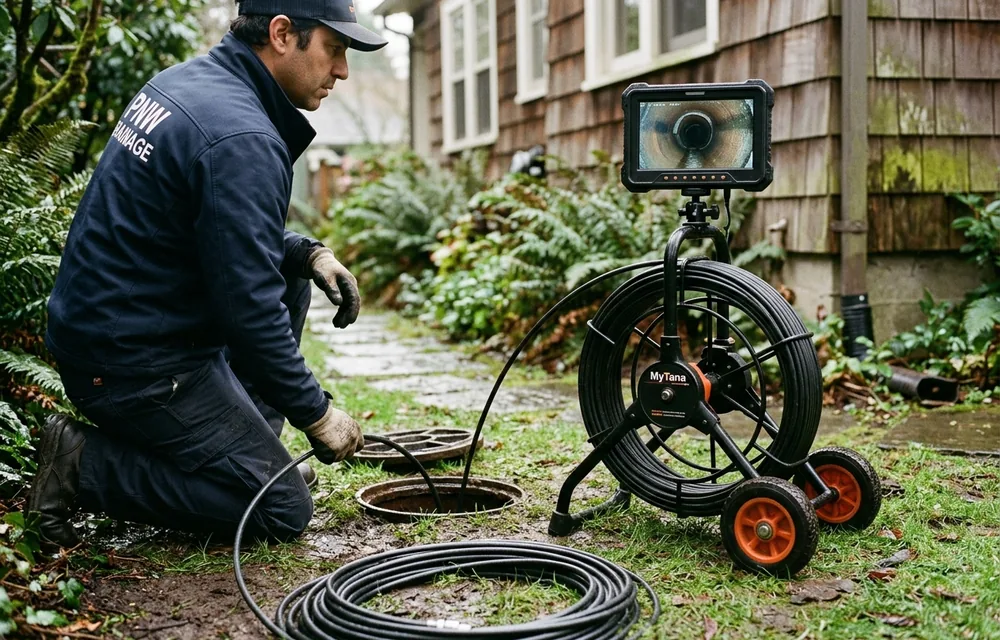
This is the part worth reading before booking a truck. A full tank and a blocked building sewer produce very similar symptoms, and the pipe between the house and the tank is ordinary plumbing — our work, not a pumper's.
A blocked or broken building sewer. The run from the house to the tank clogs, sags, separates or fills with root intrusion exactly as a municipal lateral does. Rural properties tend to have long runs of it. A camera inspection shows which it is, and drain cleaning or rooter service clears it when the line is the issue.
Roots. Septic properties are often the ones with mature trees over a long, shallow line. See tree roots in a sewer line for how that develops.
A clogged effluent filter. Many newer Oregon systems have a filter in the outlet tee that is designed to be pulled and rinsed. A blinded filter backs the house up and can be mistaken for a full tank.
A failed pump or float on any system that pumps effluent uphill to the drainfield. The symptom is a high-water alarm, or a backup with no alarm if the alarm itself has failed.
Grease. DEQ lists greases and oils, from kitchen wastewater and from household products such as fabric softeners, as part of what floats and accumulates in the tank. On septic more than anywhere, keeping fat out of the drain is maintenance; see grease in kitchen drains.
If the camera shows a clear line running into a tank that is at capacity, you need a licensed pumper and we will say so rather than sell you a cleaning you do not need.
Living on septic without paying for it twice
Find out what you have
Tank size, installation date and system type. Your county environmental health office usually holds the permit record. A tank installed before 1979 may be smaller than today's standard and need pumping more often.
Fit risers if the lid is buried
Ask at the next pump-out. It converts every future inspection and pumping from an excavation into a five-minute job.
Measure rather than guess
DEQ's trigger is sludge and scum above 35 percent of tank volume. Have it checked at the interval that fits your household size, and pump when the measurement says so.
Keep solids and grease out
DEQ names laundry lint, garbage disposal waste, greases and oils among what builds the sludge and scum layers. A garbage disposal on septic measurably shortens the interval between pump-outs; our garbage disposal guide covers removing one.
Spread the water load
Doing every load of laundry on one day pushes a week of flow through the tank in an afternoon, which is exactly when solids get carried into the drainfield.
Keep the drainfield clear
No vehicles, no stacked firewood, no new planting with ambitious roots. It is the most expensive component and the easiest one to damage by accident.
Frequently asked questions
How often should a septic tank be pumped in Oregon?
DEQ says a properly sized tank typically holds three to eight years of use, and recommends pumping once sludge and scum exceed 35 percent of the tank volume. Its worked example: four people in a four-bedroom house on a 1,000-gallon tank is on the order of every three years, while two people on the same system is on the order of every six. Tanks installed before 1979 may be smaller and need it sooner.
Can a plumber pump my septic tank?
Not unless that business also holds an Oregon DEQ sewage disposal service licence, which is a separate licence covering pumping, transporting and disposing of septic contents. We do not pump tanks. DEQ publishes a licence search so you can confirm a pumper's licence and bond are current before hiring.
What does septic tank pumping cost in Oregon?
It varies enough that a single figure would mislead. The price moves with tank size and how full it is, how far the truck has to run its hose, whether a buried lid has to be dug up first, distance to an approved disposal site, and whether the tees or baffles turn out to need repair. Scheduled pump-outs price better than emergency ones.
How do I know if it is the tank or a blocked pipe?
Symptoms alone do not separate them, which is why cameras exist. A full tank and a blocked building sewer both back up the lowest fixture and slow the whole house. A camera inspection of the line between the house and the tank settles it in one visit, and if the line is clear and the tank is at capacity, the next call is a licensed pumper.
What happens if I never pump the septic tank?
Solids that should settle in the tank get carried into the drainfield instead. DEQ is explicit that the field may not fail immediately, but continued neglect will result in failure and replacement. Surfacing sewage also exposes people and animals to disease-causing organisms. The pump-out is the cheap part of that sequence.
Services mentioned in this guide
Sewer Scope & Camera Inspection
A sewer scope is the cheapest insurance in real estate and the only defensible basis for an excavation quote.
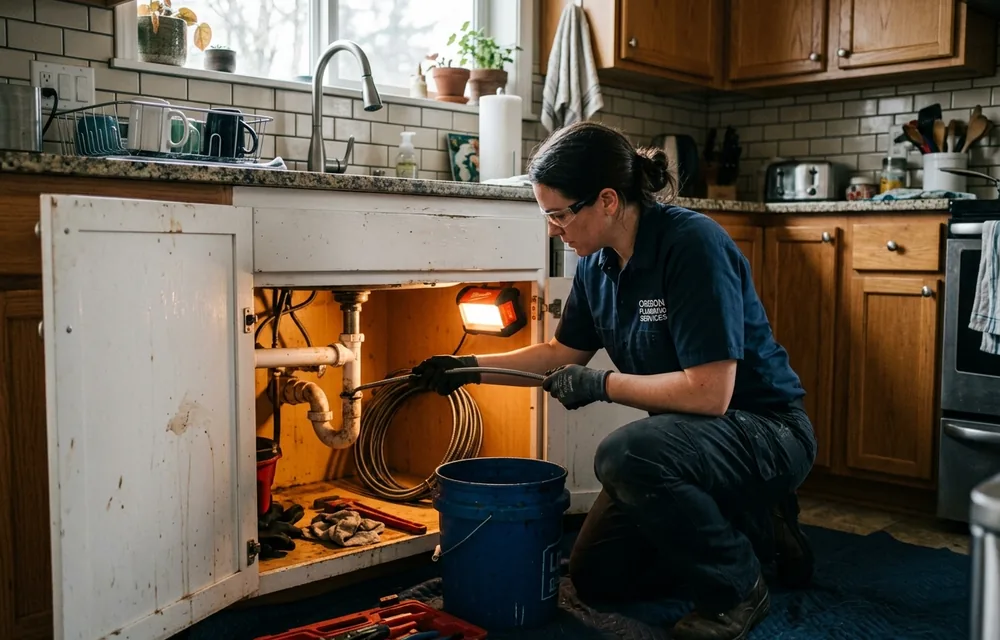
Drain Cleaning
A single slow sink is a nuisance.
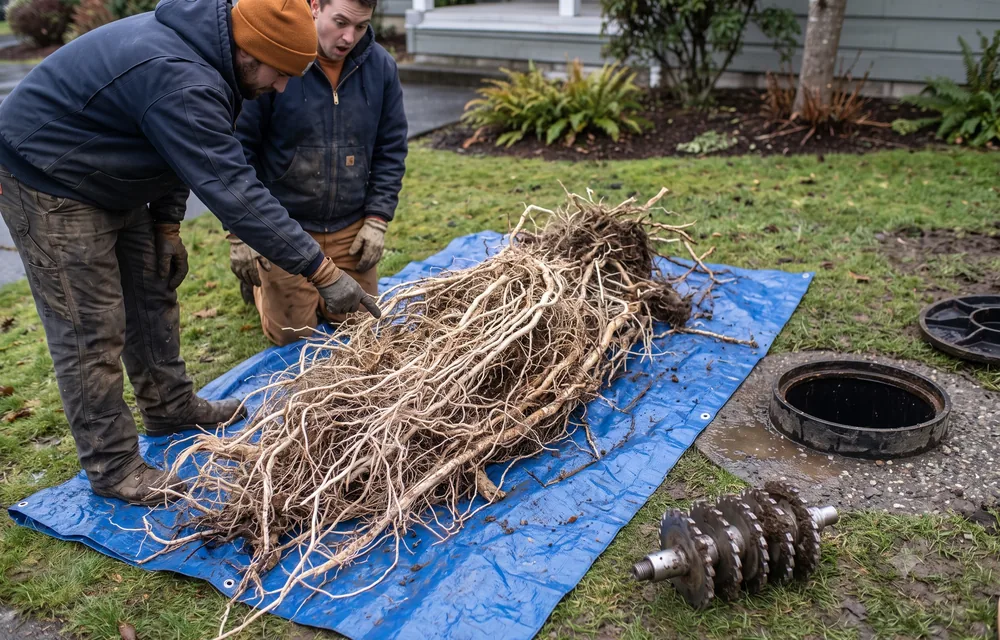
Rooter Service & Tree Root Removal
Roots do not break into a healthy pipe.
Related guides
Why Is My Toilet Gurgling? What That Sound Means
A gurgling toilet is one of the few plumbing symptoms that is almost never trivial. The sound is air being dragged thr…
How to Unclog a Drain Yourself (and When to Stop)
Most single-fixture clogs are genuinely a DIY job. Here is what works, in the order a plumber would try it — and the p…

Why You Need a Sewer Scope Before Buying an Oregon Home
Roughly $250 during your inspection contingency, to find out whether you are buying a $600 cleaning or a $14,000 repla…