Water heater replacement cost in Oregon: 2026 prices, code items and incentives
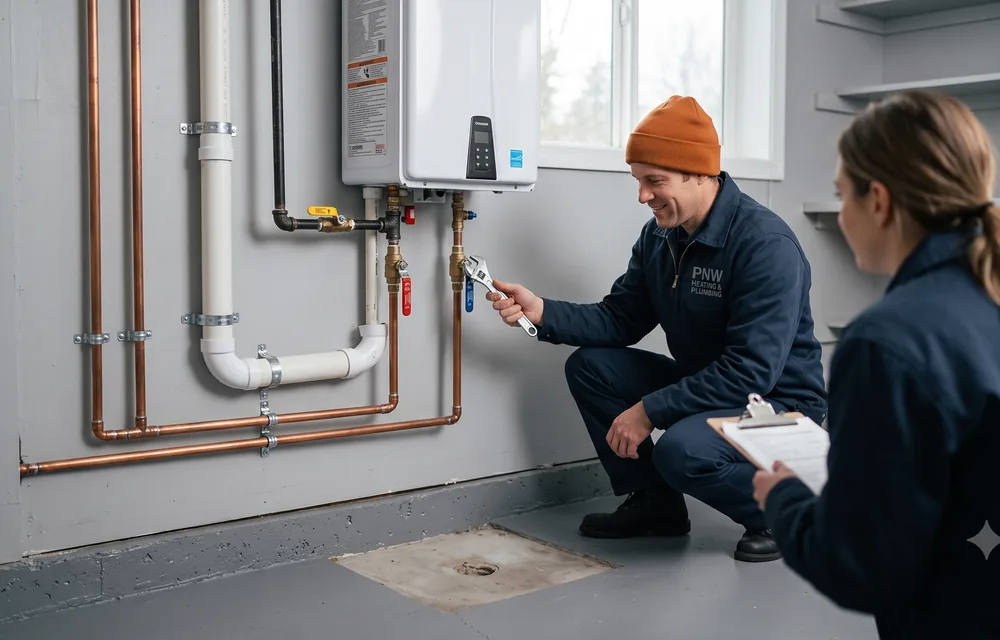
Replacing a tank water heater typically costs $600 to $2,500 installed, and a tankless unit $1,400 to $3,900, according to NerdWallet's cost guide. A heat pump water heater averages about $3,600 installed, according to Today's Homeowner. In Oregon, three things move your number: the code items a replacement has to meet, whether your utility pays an incentive, and the fact that the federal tax credit is gone in 2026.
Published water heater prices, and how old they are
| Type | Installed price | Labour share | Source |
|---|---|---|---|
| Tank, gas or electric | $600 – $2,500 | $150 – $450 | NerdWallet, updated Sept 2025 |
| Tankless | $1,400 – $3,900 | $600 – $1,900 | NerdWallet, updated Sept 2025 |
| Heat pump, all sizes | $1,200 – $6,000 (average about $3,600) | $600 – $2,000 | Today's Homeowner, updated Apr 2025 |
| Heat pump, 50 gallon | $1,500 – $2,800 | included | Today's Homeowner, updated Apr 2025 |
These are national figures. None of the major cost guides publishes Oregon-only prices that can be checked, so treat the table as a range for sanity-checking a quote, not as the price of your job. NerdWallet makes the point that professional labour is more than half the total cost of a new water heater, which is why two quotes for the same unit can be far apart.
Notice the dates. A cost guide written before 2026 may still subtract a federal tax credit that no longer exists; Today's Homeowner's heat pump guide, for example, still describes the 30% credit. The prices in these guides are still useful. Any net price that depends on the federal credit is not.
The wide ranges are not sloppiness. A 40-gallon electric tank swapped like for like in an open garage and an 80-gallon unit carried down a crawlspace hatch are both "water heater replacement". The sections below cover what pushes a job toward either end.
What Oregon code requires when you replace a water heater
Oregon's Building Codes Division has issued a statewide code interpretation, legally binding across the state, on exactly this question: when a water heater is replaced in an existing home, which parts of the 2023 Oregon Plumbing Specialty Code must be brought up to date? Its answer lists five items that are necessary to protect health and safety:
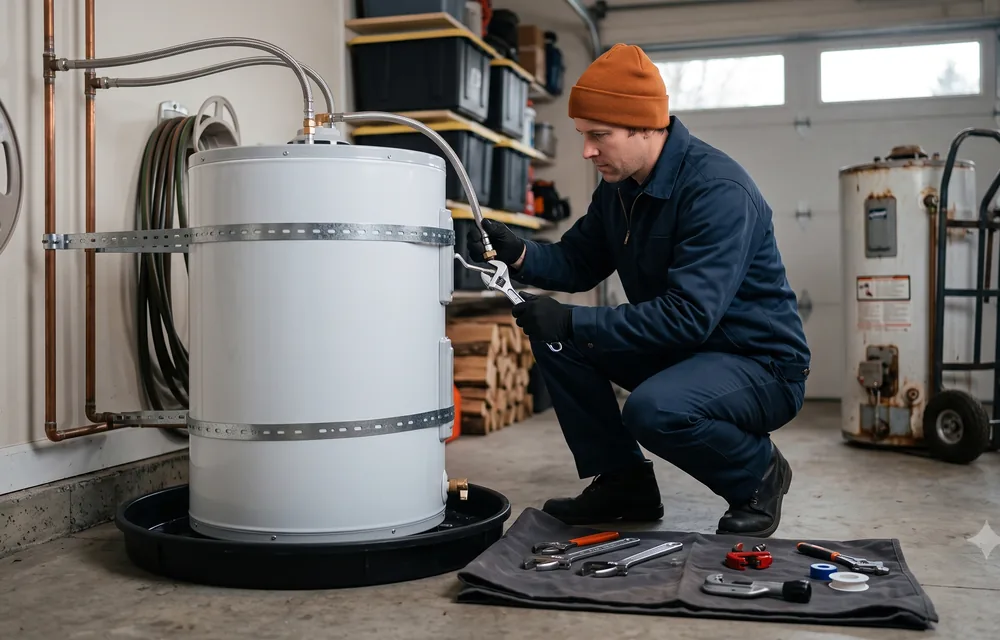
- Seismic anchoring or strapping (Section 507.2). The tank must be secured to the structure so an earthquake cannot topple it, break the gas line or tear the water connections.
- Relief valve termination (Section 608.5). The temperature and pressure relief valve has to discharge through a pipe to an approved location, so a scalding release goes somewhere safe rather than onto whoever is standing nearby.
- Thermal expansion protection (Section 608.3). Water expands as it heats. In a closed system, where a check valve or pressure regulator stops it pushing back into the main, that expansion needs somewhere to go; usually an expansion tank.
- Combustion air (Section 505.0). A gas water heater needs enough air to burn cleanly. A new unit in a tight closet that was never given proper air openings is a carbon monoxide risk.
- Raising water heaters in garages (Section 507.6), which keeps the ignition source of a gas unit up out of the way of fuel vapour at floor level.
The same interpretation lists three things that are not necessary to bring up to code at replacement: water pipe sizing, a water heater drip pan, and existing water pressure above 80 psi.
This is the practical meaning for your price: a low quote that leaves out strapping, the relief valve discharge or an expansion tank on a closed system is not a cheaper version of the same job. It is an incomplete one, and it will not pass inspection. When you compare quotes, ask each one whether those items are included.
Do you need a permit?
In Portland, yes. The city's residential plumbing permit page lists "replace a water heater" among the work that needs a plumbing permit, and the fee comes from the city's fee schedule based on the fixtures and the work involved. Other Oregon cities and counties run their own permit counters, so check with your local building department; the code items above apply statewide either way.
Portland also allows homeowners to do their own plumbing work, provided the homeowner is the recorded owner of the property with the county and not an LLC. Doing it yourself still means the permit and the inspection. The inspection is where the strapping, relief valve and expansion tank get checked, which protects you whoever did the work.
Some incentives also depend on who does the work: Energy Trust's $1,200 heat pump incentive requires installation by a licensed contractor, while its $1,000 in-store discount does not.
What changed in 2026: incentives instead of a tax credit
The federal Energy Efficient Home Improvement Credit paid up to $2,000 toward a qualifying heat pump water heater, but the IRS lists it only for equipment placed in service by the end of 2025. For a 2026 replacement, the money that is left is local:
- Energy Trust of Oregon, for customers of PGE, Pacific Power, NW Natural, Cascade Natural Gas or Avista: $1,200 for a contractor-installed heat pump water heater, $1,000 as an instant in-store discount, and $400 for a qualifying gas tankless unit replacing a gas tank.
- EWEB in Eugene: $1,100 per heat pump water heater, $2,200 for income-qualified owner-occupied homes.
- Oregon's state rebates (HEAR and HOMES): not open. The Department of Energy says no rebates are currently available.
Every condition, and how to claim each one without forfeiting it, is in our guide to Oregon water heater rebates and tax credits in 2026.
Put together with the prices above: a heat pump water heater at the $3,600 average, minus Energy Trust's $1,200, is about $2,400, which lands it inside the range for a standard tank. That is an illustration from published averages, not a price for any particular house, but it shows why the 2026 comparison looks different from the sticker prices.
Tank, tankless or heat pump: comparing more than the sticker
A standard tank is the lowest installed price and the simplest like-for-like swap. It attracts no incentive in 2026. A tank in Oregon typically lasts eight to twelve years, so the replacement price comes round again.
A heat pump water heater is the one the incentives favour, and it is very efficient, but it needs the right room. It pulls heat from the air around it, so it wants a garage or basement with real air volume, and it cools that space slightly. In a small interior closet it is the wrong choice at any price. Energy Trust's incentive also requires it to replace an electric tank.
A tankless unit lasts longest, commonly fifteen to twenty years, and never runs out mid-shower if it is sized correctly. Its installed price climbs with gas line and venting work, and gas supply is the most common and most expensive surprise in a tankless conversion. Sizing matters more in Oregon than the manufacturer ratings suggest, because winter groundwater arrives cold; the water heater sizing calculator uses Oregon inlet temperatures.
The tankless installation and water heater repair and replacement pages go deeper on each.
What pushes a replacement price up or down
Most of the spread between the low and high ends of the published ranges comes from a handful of things you can check before anyone arrives:
- Access. An open garage is the cheap case. A closet, an attic, or a crawlspace hatch that the old tank has to come out through adds labour, and sometimes means cutting the old tank up to remove it.
- Like for like, or a change. Swapping gas for gas or electric for electric reuses the existing connections. Switching fuel means a new circuit or a new gas line, and switching to tankless usually means new venting.
- Code items already in place. If the old installation already has proper strapping, relief valve discharge and an expansion tank where needed, less has to be added. If it has none of them, all three are part of the job.
- Size. A larger tank costs more to buy and more to move, and an undersized tankless unit is money wasted.
- Timing. A planned replacement on a weekday is a different job from an emergency call on a Sunday night with water on the floor, and after-hours work carries a premium.
- Haul-away. Confirm whether removing and disposing of the old tank is included in the price you are given.
Replace it before it chooses the day for you
The cheapest water heater replacement is the one you plan. Most tanks give months of warning before they fail: rust-coloured hot water, rumbling as sediment boils, a slow weep at the base, or a tank past its tenth birthday. Our guide to how long a water heater lasts lists the eight signs and which of them are cheap fixes rather than a replacement.
Planning ahead also gives you time to use the incentives properly: to confirm your utility, pick a listed model, buy it the way the incentive requires, and, where the incentive is claimed after installation, file within 60 days. Those steps are easy on a Tuesday and impossible on the morning the tank lets go.
If the tank is already leaking, turn off the cold supply at the top of the tank and the power or gas to it, and call. Everything else in this guide can wait until the water is off.
Frequently asked questions
How much does it cost to replace a water heater in 2026?
National cost guides put a standard tank at about $600 to $2,500 installed, a tankless unit at $1,400 to $3,900, and a heat pump water heater at an average of about $3,600. Where a job lands depends on access, whether you are changing fuel or type, the code items the replacement must meet, and timing. These figures are market information, not a quote for any home.
Is there a tax credit for a new water heater in 2026?
No. The federal Energy Efficient Home Improvement Credit, which paid up to $2,000 toward a qualifying heat pump water heater, only applies to equipment placed in service by the end of 2025. In Oregon, the incentives still available in 2026 come from Energy Trust of Oregon and utilities such as EWEB.
Do I need a permit to replace a water heater in Oregon?
In Portland, yes: replacing a water heater requires a plumbing permit, and homeowners who are the recorded owner of the property can pull one for their own home. Other cities run their own permit counters, so check with your local building department. The code items required at replacement, such as seismic strapping, apply statewide.
Does Oregon require earthquake straps and an expansion tank on a replacement water heater?
Oregon's Building Codes Division lists seismic strapping, relief valve discharge piping, thermal expansion protection, combustion air, and raising units in garages as items a replacement must address. An expansion tank is the usual form of thermal expansion protection on a closed system. A drip pan is not required at replacement.
Is a heat pump water heater worth it in Oregon in 2026?
Often, if you have the right space. With Energy Trust's $1,200 incentive, a heat pump unit at the published $3,600 average comes to about $2,400, close to a standard tank. It needs a garage or basement with air volume, not a small closet, and Energy Trust's incentive requires it to replace an electric tank.
Services mentioned in this guide
Water Heater Repair & Replacement
Most water heater calls split cleanly into two groups: a $200 part on a tank worth keeping, and a tank that has already failed and is quietly ruining the floor.
Tankless Water Heater Installation
Tankless is a genuinely better appliance for the right house and a frustrating, expensive mistake in the wrong one.
Water Service Line Replacement
The water service line is the pipe carrying potable water from the meter to your house.
More guides
How to Unclog a Drain Yourself (and When to Stop)
Most single-fixture clogs are genuinely a DIY job. Here is what works, in the order a plumber would try it — and the p…
Sewer Backup: What to Do in the First Ten Minutes
A main line backup gets measurably worse with every gallon of water the household uses. What you do in the first ten m…
Winterize Oregon Plumbing: 2026–27 Winter Checklist
For winter 2026–27, NOAA forecasts a very strong El Niño, which usually tilts Oregon toward a warmer, drier winter, bu…