Hard water in Oregon — where it is worst, and what it is costing you
Oregon has one of the widest ranges of water hardness of any state, and it splits almost exactly along the Cascades. Portland draws some of the softest municipal water in the country. Two hundred miles east, Bend and Klamath Falls run water hard enough to shorten the life of every appliance in the house. Which side you are on changes what your plumbing needs.
What hardness actually is
Water hardness is dissolved calcium and magnesium, picked up as groundwater moves through rock. It is measured either in parts per million (or the equivalent milligrams per litre) or in grains per gallon, where one grain per gallon is about 17.1 ppm.
The conventional scale: under 60 ppm is soft, 60 to 120 is moderately hard, 120 to 180 is hard, and above 180 is very hard. Nothing about hardness is a health concern — calcium and magnesium in drinking water are, if anything, mildly beneficial. It is purely a plumbing, appliance and laundry problem.
The mechanism that matters is precipitation. Dissolved calcium carbonate stays dissolved in cold water and comes out of solution when the water is heated or when it evaporates. That is why hardness damage concentrates in exactly three places: water heaters, anything that sprays and dries, and any narrow passage that carries hot water. Cold supply piping is largely unaffected.
The Oregon map, west to east
Portland and the Bull Run watershed. Portland's primary supply is surface water from the Bull Run, and it is remarkably soft — typically in the low single digits of ppm, among the softest municipal supplies in the United States. When the city runs its Columbia South Shore Well Field during high demand or turbidity events, hardness rises but stays low by national standards. Practical effect: essentially none. Portland-area tanks are not killed by scale, and a water softener in Portland is a solution looking for a problem.
The Willamette Valley — Salem, Eugene, Springfield, Corvallis, Albany, McMinnville. Mostly soft to moderately soft on municipal supply, drawn from surface sources including the Willamette, the McKenzie and the Santiam. Rural properties on wells are a different matter entirely and can be moderately hard to hard depending on the aquifer. If you are in the valley and on a well, test rather than assume.
Central Oregon — Bend, Redmond, Prineville. Groundwater through volcanic rock, and genuinely hard. This is where scale becomes a real maintenance factor: shortened water heater life, scaled shower heads and aerators that need descaling several times a year, spotting on glass and fixtures, and — importantly — a materially higher maintenance burden on tankless water heaters.
Klamath Falls and the Basin. Hard, and with the added complication of geothermal influence in parts of the area. Klamath Falls sits on a well-known geothermal resource, and where that interacts with domestic supply, mineral content and temperature both rise.
Southern Oregon — Medford, Ashland, Grants Pass, Roseburg. Moderate, varying by source. Medford draws largely from Big Butte Springs, which is comparatively soft; wells in the Rogue and Umpqua valleys vary considerably.
The coast — Florence, Newport, Coos Bay. Generally soft on municipal supply. The coastal plumbing problems are different ones: salt air corrosion on exterior fittings, and sand and organic material in groundwater on private wells.
Two caveats worth stating plainly. First, these are general patterns, and your utility publishes an annual Consumer Confidence Report with the actual number for your address — that is the figure to use. Second, if you are on a private well, none of the municipal figures apply to you at all, and a $20 test kit is the only way to know.
What hardness costs you, item by item
| What it affects | What happens | Practical cost |
|---|---|---|
| Tank water heater | Scale layer on the tank floor insulates the burner; longer cycles, hotter steel | Years off an 8–12 year life; popping and rumbling |
| Tankless water heater | Scale in the narrow heat exchanger passages | Annual descaling required; ignored, it can halve the unit life |
| Shower heads and aerators | Nozzles scale closed | Descaling several times a year; weak spray between |
| Dishwasher | Spotting, film, scaled heating element | More detergent, shorter element life |
| Washing machine | Detergent binds with minerals instead of soil | 20–30% more detergent for the same result |
| Faucet cartridges and valves | Abrasive scale on moving seals | Faster wear, earlier drips |
| Toilet fill valves | Scale on the diaphragm | Running toilets, earlier replacement |
| Hot supply piping | Progressive narrowing in older galvanised | Reduced hot-side flow over years |
| Glass, tile and fixtures | Visible spotting and film | Cleaning time, and etched glass over years |
The single largest financial line is the water heater. In very hard water, an unflushed tank can lose several years off its life, and on a $1,200 to $2,800 replacement that is real money arriving early.
Test before you spend anything
Read your utility's annual report
Every Oregon municipal supplier publishes a Consumer Confidence Report with measured hardness. It is free, it is specific to your supply, and it is more accurate than any general map including this one.
If you are on a well, buy a test kit
Around $20 for strips, or $30 to $60 for a mail-in laboratory test that also covers iron, manganese, pH, nitrate and bacteria. Well water in Oregon varies enormously over short distances, and iron and manganese cause staining problems that a softener sized only for hardness will not fix.
Look at your own fixtures
Pull a shower head and look inside. Check the aerator screens. Look at the glass in the shower. White crusty deposits on anything that sprays and dries is hardness making itself visible, and the rate at which it returns after cleaning tells you more than any number.
Listen to the water heater
Popping and rumbling during a heating cycle means a sediment layer on the tank floor. In hard water areas that is the earliest and clearest signal, and it means the flushing interval needs to be shorter than annual.
Decide with the number, not the sales pitch
Under about 120 ppm, treatment is generally not worth the capital or the running cost. Between 120 and 180, it is a judgement call driven by whether you have tankless and how much the cosmetic effects bother you. Above 180, treatment usually pays for itself through appliance life alone.
Treatment options, honestly compared
Ion-exchange softener. The only technology that genuinely removes hardness. Resin beads swap calcium and magnesium for sodium, and regenerate periodically with a brine solution. Installed cost typically $1,200 to $3,500, plus salt and the water used in regeneration. It works, comprehensively, and it is what to fit if the hardness number is high and you want the problem gone.
Two considerations specific to Oregon. Softened water is slightly more aggressive toward copper and toward the sacrificial anode in a water heater, so a softened house wants the anode checked more often, not less. And discharge matters: brine regeneration to a septic system is a real consideration for the drain field, and some Oregon jurisdictions have restrictions on softener discharge to sewer. Ask before you install.
Salt-free conditioners (template-assisted crystallisation). These do not remove hardness. They convert dissolved hardness into microscopic crystals that are less inclined to stick to surfaces. They reduce scale formation in pipes and heaters meaningfully, they do nothing for spotting on glass or for laundry, and the water is still hard by any measurement. Roughly $800 to $2,000. They are a reasonable choice where a softener is impractical or where discharge is restricted, provided you understand what they do and do not do.
Point-of-use scale filters ahead of a tankless unit. A cartridge inline before the heater, roughly $150 to $400 plus cartridges. Protects the single most vulnerable appliance without treating the whole house. In Bend or Redmond with a tankless unit and moderate hardness, this is frequently the best value option on the list.
Magnetic and electronic descalers. Independent evidence for these is weak and inconsistent. Not worth the money.
Doing nothing, plus discipline. Flushing the tank twice a year, descaling shower heads and aerators quarterly, and descaling a tankless unit annually costs nothing but time and captures a large fraction of the benefit. In moderately hard water this is often the right answer.
Tankless in hard water: the thing people get wrong
This deserves its own section because it is the most expensive mistake made in Central Oregon.
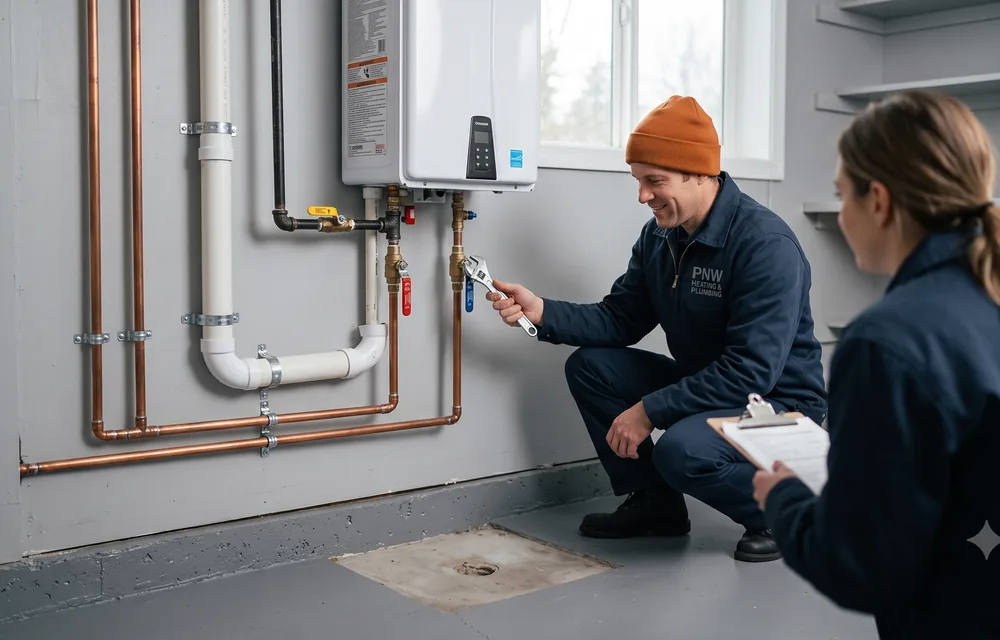
A tank water heater tolerates hardness poorly but slowly. Scale settles on the floor of a large vessel, and the vessel keeps working — noisily, inefficiently, for years. A tankless unit is the opposite. Water passes through narrow heat exchanger passages at high temperature, which is close to ideal conditions for depositing calcium carbonate, and there is no large volume to buffer it. Passages narrow, flow drops, the unit starts short-cycling and throwing error codes, and eventually the heat exchanger — the expensive part — is done.
Every tankless manufacturer specifies descaling. In soft Portland water, once every two or three years is realistic. In Bend, Redmond, Prineville or Klamath Falls, or on hard well water anywhere, it is annual and not optional, and many manufacturers make the warranty conditional on it.
Descaling is a straightforward procedure — isolation valves, a small pump, and a food-grade descaling solution circulated for an hour. It runs $150 to $300 as a service call, or you can do it yourself for the cost of a $150 pump kit and an afternoon. What matters is that it happens.
If you are considering tankless installation in a hard water area, budget for either a scale filter ahead of the unit or a softener, and factor annual descaling into the running cost when you compare it against a tank. Our sizing and payback calculator includes that maintenance in the comparison, because leaving it out makes tankless look better than it is.
What hard water does not cause
A useful list, because hardness gets blamed for a lot.
It does not cause drain clogs. Drain and sewer blockages are grease, hair, roots, wipes and pipe defects. Hardness acts on the supply side, where water is heated and pressurised, not on the waste side. If your drains are slow, look at our clogged drain guide rather than at your water.
It does not cause a rotten-egg smell. That is sulfate-reducing bacteria reacting with the anode rod in your water heater, and it is a separate problem with a separate $40 fix.
It does not cause rusty water. That is iron — either in the supply, or from a corroding tank or galvanised piping. A softener will remove modest amounts of dissolved iron as a side effect, but iron staining needs its own treatment.
It is not a health risk. No Oregon utility treats hardness as a safety parameter, because it is not one.
And it does not cause low water pressure, except over decades in old galvanised hot-side piping. Sudden pressure loss is a valve, a pressure reducing valve or a leak — see our low water pressure guide.
Frequently asked questions
Is Portland water hard or soft?
Very soft. Portland's primary supply is surface water from the Bull Run watershed, and it is among the softest municipal water in the United States — typically in the low single digits of ppm. When the Columbia South Shore Well Field supplements supply during peak demand, hardness rises but remains low by national standards. A water softener in Portland solves a problem you do not have.
Why is Bend water so hard?
Central Oregon supply is groundwater that has moved through volcanic rock, which dissolves calcium and magnesium along the way. That is a straightforward geological difference from the surface-water supplies west of the Cascades. The practical consequences in Bend, Redmond and Prineville are shorter water heater life without regular flushing, frequent descaling of shower heads and aerators, and a genuine annual descaling requirement on tankless units.
Do I need a water softener in Oregon?
It depends entirely on your number, not your state. Under about 120 ppm, no — the capital and running cost will not pay back. Above 180 ppm, usually yes, and appliance life alone tends to justify it. Between the two, the deciding factors are whether you have a tankless water heater, whether you are on a septic system that complicates brine discharge, and how much the cosmetic effects bother you. Get your utility's annual report, or test if you are on a well, before spending anything.
How often should I flush my water heater in hard water?
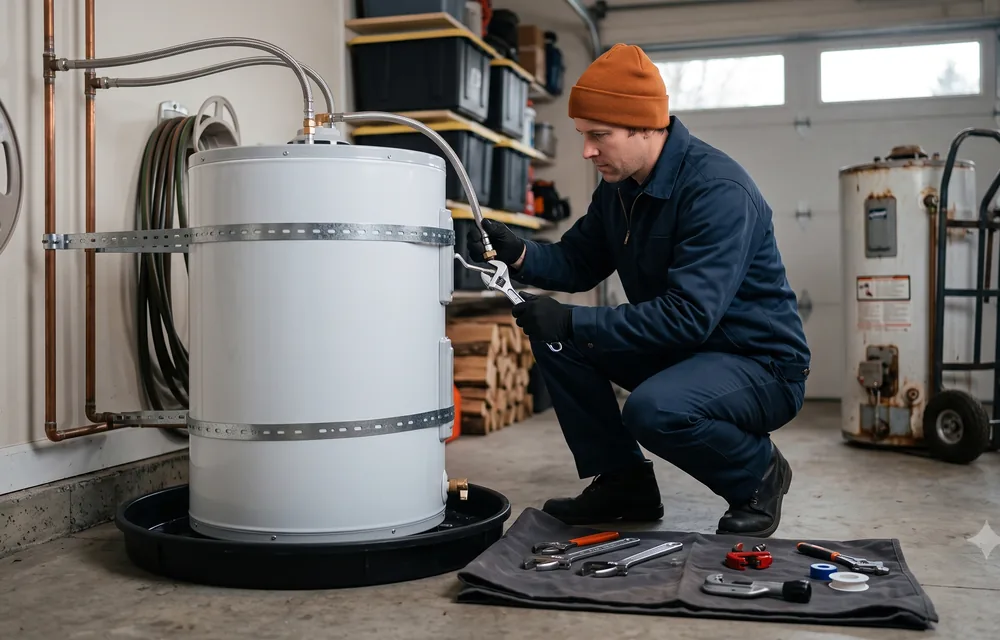
Twice a year in Bend, Redmond, Prineville, Klamath Falls or on hard well water; annually elsewhere in Oregon. It takes about twenty minutes: shut off the gas or breaker, close the cold inlet, open a hot tap somewhere in the house, and drain through a hose at the tank's drain valve until the water runs clear. It is the single highest-value maintenance task on a tank, and the one almost nobody performs.
Will a water softener damage my pipes or water heater?
Not directly, but softened water is slightly more aggressive toward copper and toward the sacrificial anode rod in a tank heater, so the anode is consumed faster. Check it every two years in a softened house rather than every three to five. The other thing to plan for is discharge: brine regeneration into a septic system affects the drain field, and some Oregon jurisdictions restrict softener discharge to sewer. Confirm both before installation.
Services mentioned in this guide
Water Heater Repair & Replacement
Most water heater calls split cleanly into two groups: a $200 part on a tank worth keeping, and a tank that has already failed and is quietly ruining the floor.
Tankless Water Heater Installation
Tankless is a genuinely better appliance for the right house and a frustrating, expensive mistake in the wrong one.
Hydro Jetting
A cable bores a hole through the clog.
More guides
How to Unclog a Drain Yourself (and When to Stop)
Most single-fixture clogs are genuinely a DIY job. Here is what works, in the order a plumber would try it — and the p…
Sewer Backup: What to Do in the First Ten Minutes
A main line backup gets measurably worse with every gallon of water the household uses. What you do in the first ten m…
Winterizing Plumbing in Oregon: A Regional Checklist
Generic winterizing advice is written for the Midwest and it is either overkill or dangerously inadequate depending on…