Orangeburg pipe: the postwar sewer line that was never meant to last this long
Orangeburg is sewer pipe made of wood fibre and coal tar. It was a genuine, standards-approved product: the US Department of Commerce promulgated Commercial Standard CS116-44 for "bituminized-fibre drain and sewer pipe" in March 1944, and the standing committee behind it was chaired by the Fibre Conduit Company of Orangeburg, New York, which is where the nickname comes from. It went into a great deal of postwar housing, including a large share of Oregon's. The problem is not that it was fraudulent. The problem is that it is a fibre-and-tar tube holding back wet soil, and every remaining run of it is decades past the job it was sold for.
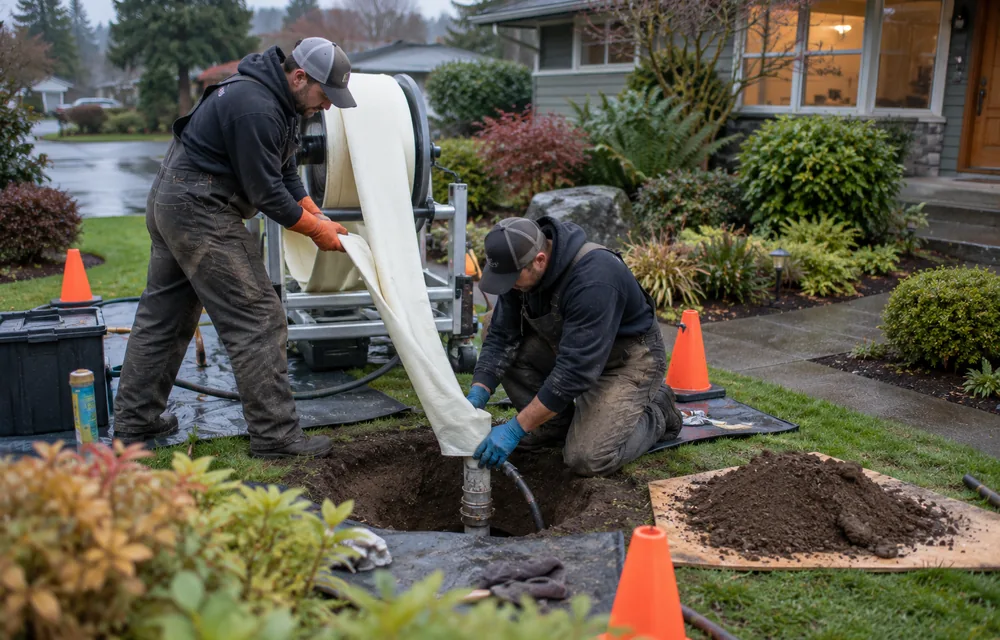
What it actually is
The 1944 federal standard describes the material precisely: pipe, bends and couplings "composed of a bituminous compound reinforced with an interwoven fibrous structure", with a wall that had to be "dense and homogeneous, without seams or laminations". You can read Commercial Standard CS116-44 in full; it is ten pages and surprisingly readable. Pinellas County, which runs a private sewer lateral programme and deals with the stuff constantly, puts it in plainer words: "Orangeburg is a fiber material made of wood pulp sealed with coal tar."
It came in 2 to 8 inch diameters, in 5 and 8 foot lengths, joined not by bell and spigot but by a machined taper on each end and a taper sleeve coupling pushed over the joint. The standard explicitly lists "house connections to sewers and septic tanks" as an intended use, alongside downspouts, storm drains and farm drainage.
Why it spread is no mystery either. As Pinellas County explains, laterals of this material "were commonly installed during World War II because the material was inexpensive and there was a cast iron pipe shortage at the time". It was light enough for two people to carry a bundle, it cut with a handsaw, and it was cheap in exactly the years when America was building housing at enormous speed.
The failure was designed for, and then outlived
The most interesting thing about CS116-44 is how much of it is about the pipe not deforming. The standard sets a water absorption limit: a specimen soaked for 48 hours could not gain more than 2 percent in weight. It sets a flattening test: loaded and held at 120°F for 48 hours, the decrease in diameter "shall not exceed 3 percent". It sets a heat resistance test at 180°F for 8 hours with "no appreciable exudation of pitch or flattening of the pipe".
Read those together and the material's weaknesses are written into its own specification. It absorbs water. It softens with heat. It goes out of round under sustained load. The tests existed to keep manufacturing within tolerances the pipe could survive — for a while.
Now put that pipe in western Oregon: buried in soil that is saturated for months at a time, under a load that never comes off, for sixty or seventy years. The failure sequence is the one Pinellas County lists: laterals of this material "are susceptible to sags (known as bellying), tree root intrusion, and groundwater infiltration, and they deteriorate at a faster rate than other types of pipes".
What it looks like on camera
On a camera inspection, Orangeburg is usually unmistakable to anyone who has seen it before, and four things give it away.
It is not round. A healthy pipe shows a circular bore. Orangeburg that has been in the ground for decades shows an oval, then an egg shape, then a slot. The technical description is deformation; what you see is the ceiling of the pipe sagging toward the floor.
The wall looks fibrous rather than hard. Where the inner surface has worn, the layered fibre structure shows, sometimes with the surface blistering or peeling inward.
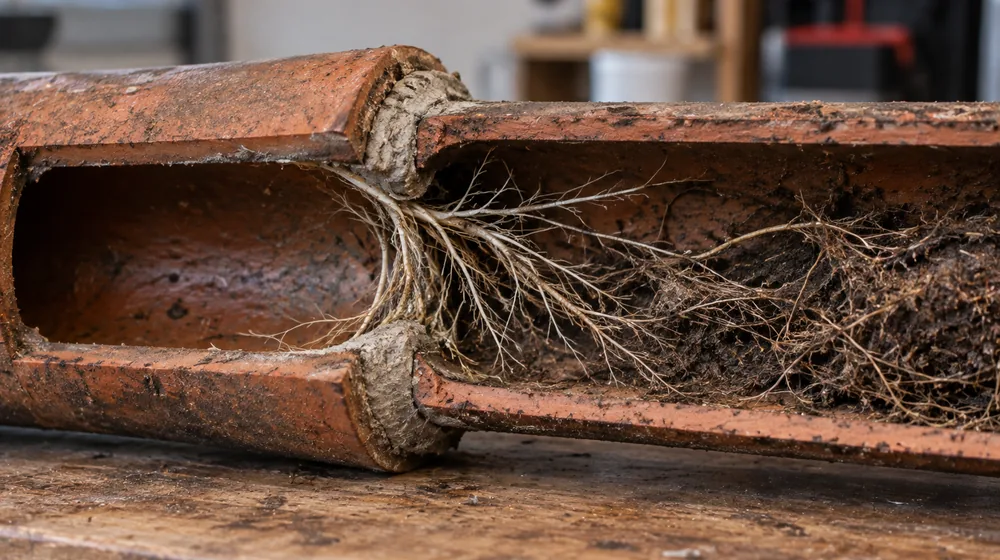
Roots come through the joints and the wall. Roots enter clay through the joints. In Orangeburg they also work through a softened wall, which is why root intrusion in this material tends to be distributed rather than concentrated at one joint.
There are bellies. Sags hold standing water, which is what the camera shows when the flow stops — the technique Portland's permitting guidance requires for video inspections, running water on the way downstream and turning it off for the pull back.
Does your Oregon house have it?
Nobody can tell you from the kerb. What they can tell you is whether you are in the window.
Build era is the first filter. Oregon housing put up between the mid-1940s and the early 1970s is where we find it. That covers an enormous amount of the state: the postwar tracts east of 82nd Avenue and out toward Parkrose in Portland, the postwar sections of Salem, Eugene and Springfield, the mill-era stock in Roseburg, and the postwar tracts through Medford.
The permit record is the second. Many Oregon jurisdictions hold sewer permit cards that name the material. A call to the local building department is free and sometimes settles it.
A camera settles it properly. If the house is in the window and the lateral has never been looked at, that is the case for a sewer scope before buying or simply a scheduled inspection, rather than waiting for the line to make the decision for you.
One useful rule: a house in the window that has *never* had a main-line problem is not evidence the pipe is fine. Orangeburg fails slowly and then suddenly. The absence of symptoms mostly measures how much capacity is left, not how much life is.
Why this is the material that rules out lining
For most failing sewer pipe, the modern answer is to line it: a resin-saturated liner cured in place inside the old pipe, creating a jointless pipe within a pipe. It is cheaper than digging and it saves the lawn, the driveway and the trees.
Lining needs a host pipe with enough structural shape left to line against. Orangeburg that has gone oval, or that has started to delaminate, frequently cannot provide that, which is why discovering it usually turns the conversation toward replacement instead: pipe bursting where the route allows, or open trench where it does not. Our sewer line repair page compares the four approaches with real numbers.
This is also the honest reason a camera matters before anyone quotes. The difference between a line that can be lined and one that cannot is often the difference between a few thousand dollars and a five-figure project, and it is not a judgement anybody can make from the symptoms.
If you have it, what to do in what order
Do not panic and do not do nothing
A deformed Orangeburg lateral that still drains is not an emergency this week. It is a capital project to plan for, ideally in dry weather and on your schedule rather than during a backup in February.
Get the footage and keep the video
Insist on a recorded file with footage marks, not a description. That file is what a second contractor prices against, and what a buyer or an insurer may ask to see.
Ask specifically whether lining is viable
It is the question that separates a repair from a replacement, and the answer should come with the footage that supports it.
Price the route, not just the pipe
What is above the line decides much of the cost: driveway, mature planting, a retaining wall, the street itself. Trenchless methods earn their premium exactly where surface restoration would be brutal.
Check who owns which part
Responsibility for the run between the building and the public main differs by jurisdiction, and some Oregon cities run assistance or low-interest loan programmes. Your city page covers the local split where we have confirmed it.
Add a cleanout while the ground is open
If the property lacks one, this is the cheapest it will ever be to add. See the sewer cleanout guide for why it changes the price of every future visit.
What not to do with it
Do not have it jetted routinely. High-pressure water is the right tool on sound pipe that is coated or rooted. On a fibre-and-tar wall that is already deforming and possibly delaminating, it is a risk, and any contractor who jets an unknown old line without looking first is gambling with your money. See hydro jetting for where the line is drawn.
Do not accept "we cabled it, you are fine" twice. Cabling an Orangeburg line clears the blockage and takes nothing off the underlying problem. Two visits in two years on a line in this era is a camera conversation, not a third cabling.
Do not pour chemical cleaner into it. Caustic products sit in standing water above a blockage and generate heat, which is the last thing a bituminous material needs. Our guide on what actually clears a drain covers the alternatives.
Do not hide it at resale. In Oregon a failing lateral reliably surfaces during a buyer's sewer scope, and discovering it in escrow costs more leverage than disclosing it did.
Frequently asked questions
What is Orangeburg pipe?
Sewer and drain pipe made of wood fibre impregnated with a bituminous compound — wood pulp sealed with coal tar, in plain terms. It was standardised by the US Department of Commerce as Commercial Standard CS116-44, effective March 1944, and takes its common name from the Fibre Conduit Company of Orangeburg, New York. It was widely used for house connections to sewers and septic tanks in postwar housing.
How do I know if my sewer line is Orangeburg?
By camera, or from the permit record. The first filter is build era: Oregon housing from the mid-1940s to the early 1970s is where it turns up. On camera it shows as a pipe that is no longer round — oval, egg-shaped or slotted — often with a fibrous-looking wall and roots entering through the wall rather than only at joints.
Why does Orangeburg pipe fail?
It absorbs water, softens with heat and deforms under sustained load. Its own 1944 standard set limits for exactly those properties: a 2 percent cap on water absorption, and no more than a 3 percent loss of diameter in a heated flattening test. Buried for decades in wet ground under constant load, it sags into bellies, takes in groundwater and lets roots through.
Can Orangeburg pipe be lined instead of replaced?
Often not. Lining needs a host pipe with enough shape left to cure a liner against, and Orangeburg that has gone oval or begun to delaminate frequently cannot provide it. That is why discovering it usually turns the discussion toward pipe bursting or open-trench replacement. A camera inspection is what settles it.
Is Orangeburg pipe still allowed?
It is not installed today; modern Oregon work uses PVC and other approved materials, and sewer work is inspected against the current Oregon Plumbing Specialty Code. Existing Orangeburg in the ground is not illegal, but it is at the end of its service life, and jurisdictions generally expect it to be replaced rather than patched when it is encountered during permitted work.
Services mentioned in this guide
Sewer Line Repair & Replacement
Sewer replacement is the largest unexpected bill most Oregon homeowners ever face on their plumbing.
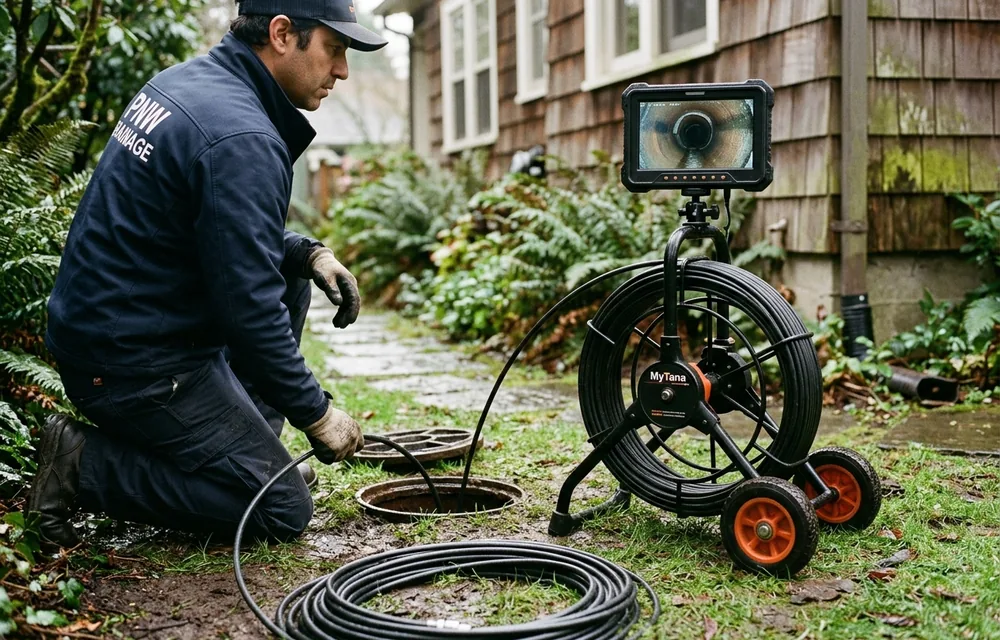
Sewer Scope & Camera Inspection
A sewer scope is the cheapest insurance in real estate and the only defensible basis for an excavation quote.
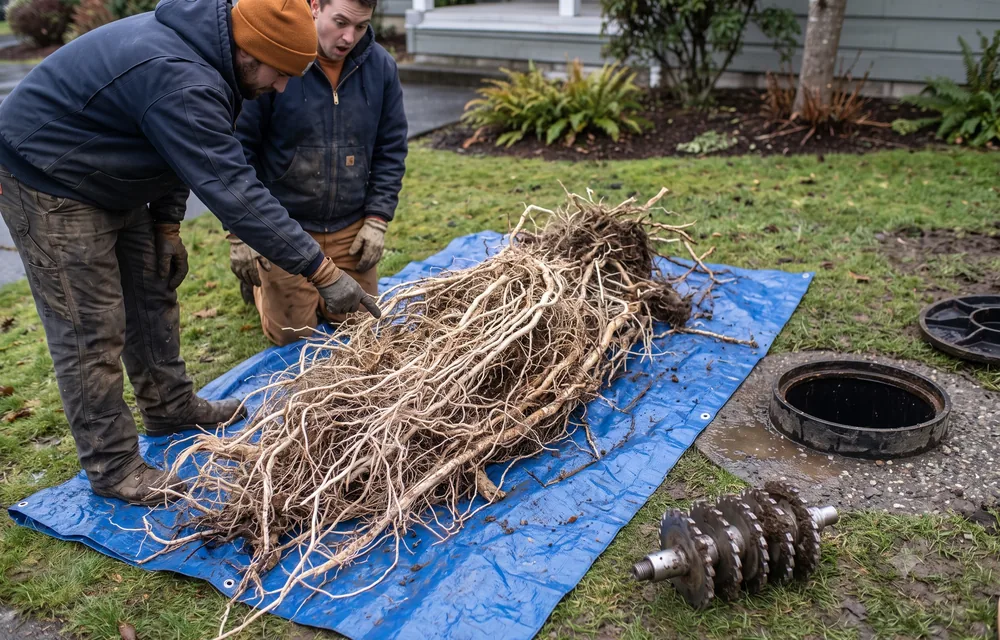
Rooter Service & Tree Root Removal
Roots do not break into a healthy pipe.
Related guides

Why You Need a Sewer Scope Before Buying an Oregon Home
Roughly $250 during your inspection contingency, to find out whether you are buying a $600 cleaning or a $14,000 repla…
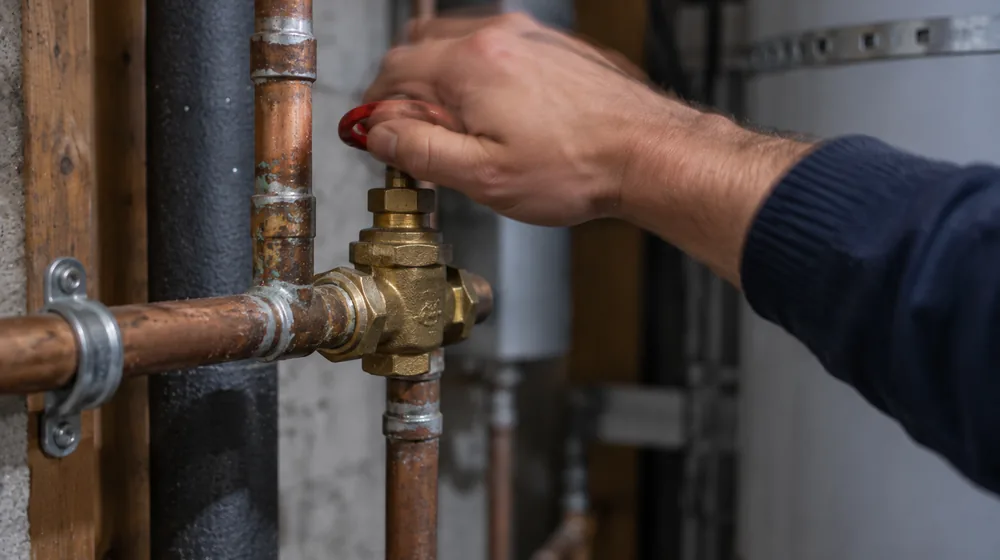
Sewer Backup: What to Do in the First Ten Minutes
A main line backup gets measurably worse with every gallon of water the household uses. What you do in the first ten m…
Tree Roots in Your Sewer Line: Why Oregon Has It Worst
Roots do not break into a healthy pipe. They find the joint that is already leaking. Understanding that single fact te…