Why is my toilet gurgling? What that sound is actually telling you
A gurgling toilet is one of the few plumbing symptoms that is almost never trivial. The sound is air being dragged through a water seal, which means something is obstructing the flow of air or water in your drain system. It is an early warning, and dealing with it now is materially cheaper than dealing with it later.
What the sound physically is
Your drain system is two systems doing one job. Wastewater flows down. Air flows in behind it, supplied by a vent that runs up through the roof. Those two have to stay balanced, because water falling down a pipe behaves like a piston: it pushes air ahead of it and creates suction behind it.
When everything works, the vent feeds air into the line and the pressure equalises silently. When something interferes — a partial blockage downstream, or a vent that cannot supply air — the system finds air wherever it can. The path of least resistance is usually the nearest water seal, which is the trap under a fixture, or in the case of a toilet, the trapway built into the china.
The gurgle is that air punching through the water. Every gurgle you hear is a small volume of your trap seal being disturbed, and if the condition persists the seal eventually breaks entirely — which is why a gurgling toilet so often becomes a sewer smell a few weeks later.
So the sound tells you two things at once. Something is wrong with airflow or drainage, and the barrier between your house and the sewer is being actively degraded.
The three causes, and how to tell them apart
There are only three realistic explanations, and you can separate them with a test that takes five minutes and costs nothing.
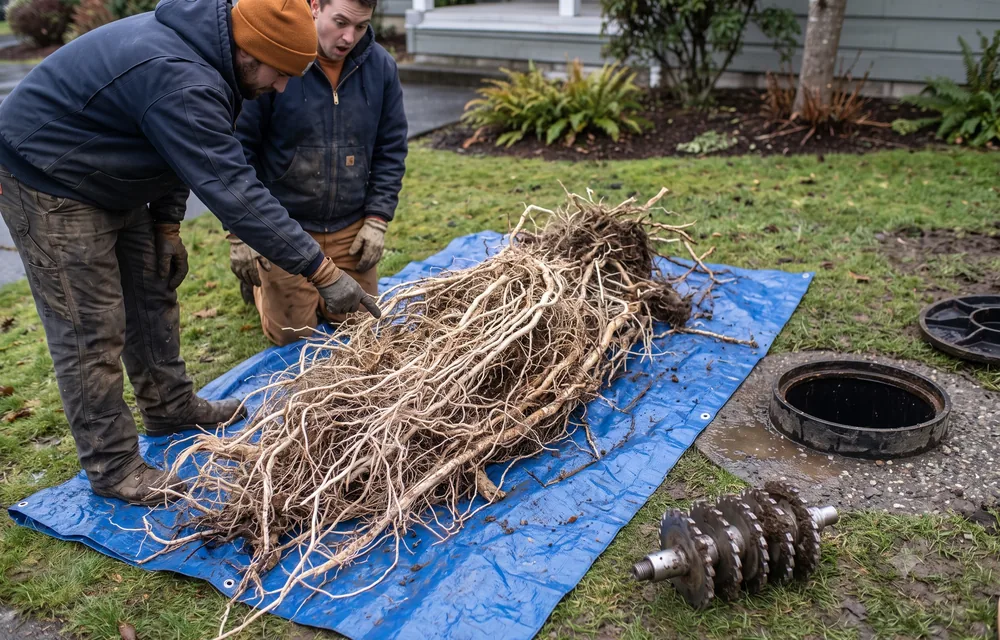
Cause 1 — a partial main line blockage. Waste is not moving freely through the main drain, so it backs up enough to trap air, and that air escapes through the lowest fixture. Toilets are usually the lowest fixture on a floor, which is why they gurgle first. This is the most common cause and, in Oregon housing, most often root intrusion or accumulated grease.
Cause 2 — a blocked or frozen vent. The vent stack is obstructed at the roof, so the system pulls its air through your traps instead. Common causes here are bird and wasp nests in spring, needle and moss packing after autumn storms, and frost closure during cold snaps in Bend, Redmond and Klamath Falls.
Cause 3 — a septic system that is full or failing. If you are on septic, a gurgling toilet is one of the earliest indicators that the tank is at capacity or the drain field is saturated. Wet ground over the field and unusually green grass there are the corroborating signs.
The five-minute test that tells you which
Isolate: flush the toilet alone
With nothing else running, flush and listen. If it gurgles by itself, air is being disturbed by the toilet's own discharge, which points at the vent or at a blockage close downstream.
Provoke it: run the nearest sink, then the shower
Run each for a minute and listen at the toilet. If the toilet gurgles when a different fixture drains, the two share a drain path and the problem is downstream of both — a main line issue.
Load it: run the washing machine drain cycle
A washer dumps a large volume very quickly, which is the hardest test a residential drain gets. If everything is quiet until the washer discharges and then the toilet gurgles or the shower burps, you have a partial main line restriction that is only exposed under volume.
Check the water level
Look in the bowl an hour after the last flush. A level that has dropped noticeably, or that visibly rises and falls on its own, is siphoning — the classic signature of a vent problem rather than a blockage.
Count the fixtures
Walk the house. If only the toilet misbehaves, suspect the vent or a local branch. If two or more fixtures on different sides of the house are slow, gurgling or backing up, it is the main line and nothing you do at a fixture will help.
If on septic, look at the yard
Walk the drain field. Soggy ground, standing water or a strip of grass that is greener and growing faster than the rest means the field is saturated. Stop running water and call — a saturated field that keeps receiving flow fails permanently.
Why Oregon lines block in the first place
The cause is fairly predictable from the age of the building and what is growing near it.
Tree roots. Roots do not break into healthy pipe. They find an existing defect — a mortared clay joint, a hairline crack, a rubber gasket that has hardened — and they enter as fine hairs following the moisture and nutrients. Once inside they thicken into a mat that catches paper and solids. The Pacific Northwest is close to ideal for this: high rainfall means shallow, aggressive, widely spread root systems, and Oregon's older neighbourhoods are planted with exactly the species that cause the most trouble — willows, poplars, silver maples, and the mature street trees that line older Portland, Salem and Eugene streets.
Grease. Kitchen waste that went down warm and liquid, met a cold pipe, and congealed onto the wall as a coating. Grease narrows a line progressively rather than blocking it suddenly, which is exactly the profile that produces a gurgle before it produces a backup.
Pipe defects. Clay laterals are common in pre-1960 Oregon housing and fail at the joints. Cast iron installed before the mid-1970s corrodes from the invert up, and the corrosion scale catches debris. Orangeburg — bituminised wood fibre, used roughly 1945 to 1972 — deforms into an oval and then collapses; every length still in service is past its design life.
Bellies. A section of pipe that has sagged, usually from settlement or poor bedding, holds standing water permanently. Solids drop out in the low spot and accumulate. A belly produces recurring symptoms that cabling relieves temporarily and never fixes.
Flushable wipes. They are not. They do not disperse, they bind with grease into a rope, and in newer housing with smaller-diameter, lower-flow systems they are the leading cause of branch and main line blockages.
What you can safely try yourself
Very little, and that is the honest answer.
Stop using water heavily. Do not run the washing machine or dishwasher until you know what you are dealing with. A partial blockage plus a large volume discharge is how a gurgle becomes a backup into a shower pan.
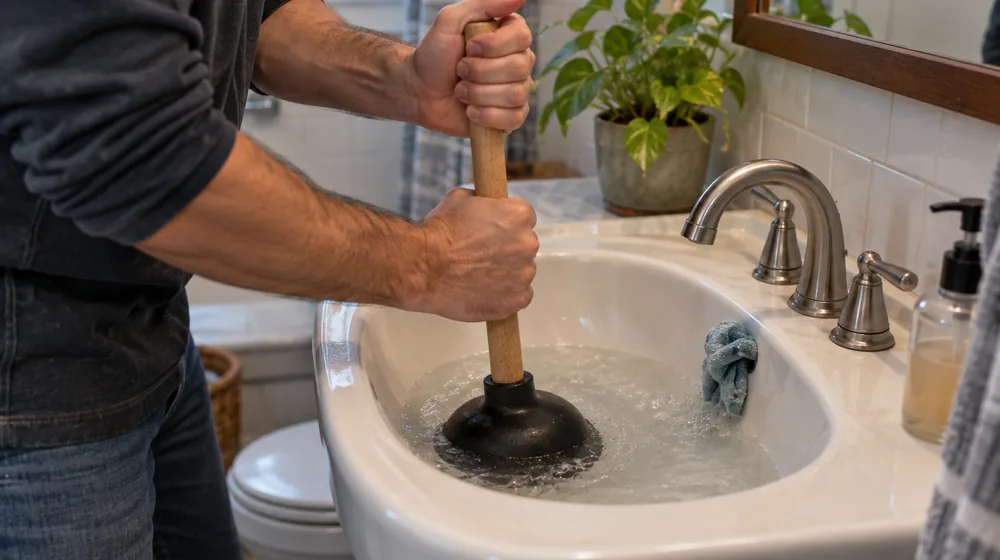
Do not plunge repeatedly. Plunging a toilet works on a blockage in the toilet's own trapway. If the obstruction is in the main line — which the gurgle suggests — plunging pushes contaminated water sideways into other fixtures without moving the blockage, because the blockage is well beyond the reach of any pressure you can generate at the bowl.
Do not use chemical drain cleaner. On a partially blocked main it never reaches the obstruction, it sits in the standing water generating heat, it accelerates corrosion in old cast iron, and it is what comes out at whoever eventually opens the line. If you have already used some, say so when you call. It is information, not a confession.
Do check the vent, if you can do it safely. From a stable roof position, look down the stack for an obvious nest or a packed mass of needles and moss, and flush it with a garden hose. If the roof is wet, steep, mossy or two storeys up, do not — vent work is a routine call and a fall is not.
Do locate your exterior cleanout. A capped three or four inch pipe near the foundation or in the front yard toward the street. Finding it before the technician arrives genuinely lowers your bill, because the alternative to a proper cleanout is pulling and resetting a toilet.
What it costs to fix
| What it turns out to be | Typical Oregon cost | Notes |
|---|---|---|
| Blocked vent cleared from the roof | $175–$350 | Single visit. Higher on a steep or two-storey roof. |
| Main line cabled through a cleanout | $249–$450 | The common outcome. Top of range with heavy root cutting. |
| Main line cabled with no cleanout access | $350–$550 | A toilet has to be pulled and reset. This is why finding the cleanout matters. |
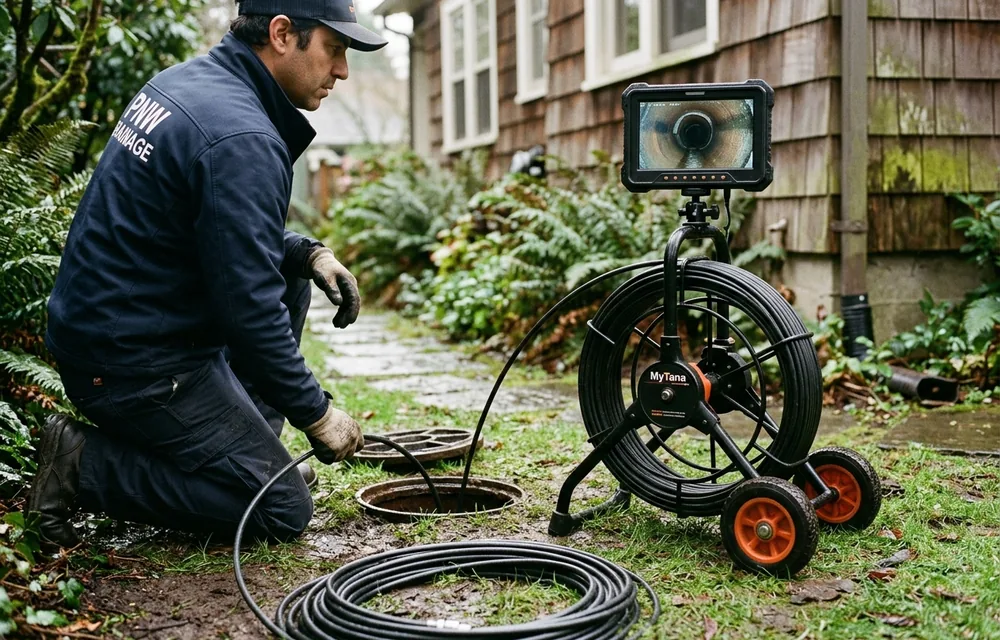
| Camera inspection | $250–$450 | Commonly credited against a repair. Ask to keep the video. |
| Hydro jetting a grease- or root-coated line | $450–$950 | Removes the coating rather than boring a channel through it. |
| Spot repair of a defective section | $2,200–$6,500 | Depends on depth, access and surface restoration. |
| Full lateral replacement | $6,000–$18,000 | Trenchless where the host pipe allows; open cut where it does not. |
| Septic tank pump-out | $400–$700 | If the gurgle is a full tank rather than a blocked line. |
After-hours, weekend and holiday calls carry a dispatch premium. It should be disclosed to you on the phone before anyone is dispatched, never added to the invoice afterward. Our cost estimator gives you a tailored range including the regional factor — the same job genuinely costs differently in Bend than in Salem, largely because of what is under the ground.
Cabling or jetting: which your line actually needs
This matters because it determines whether you are back on the phone in six months.
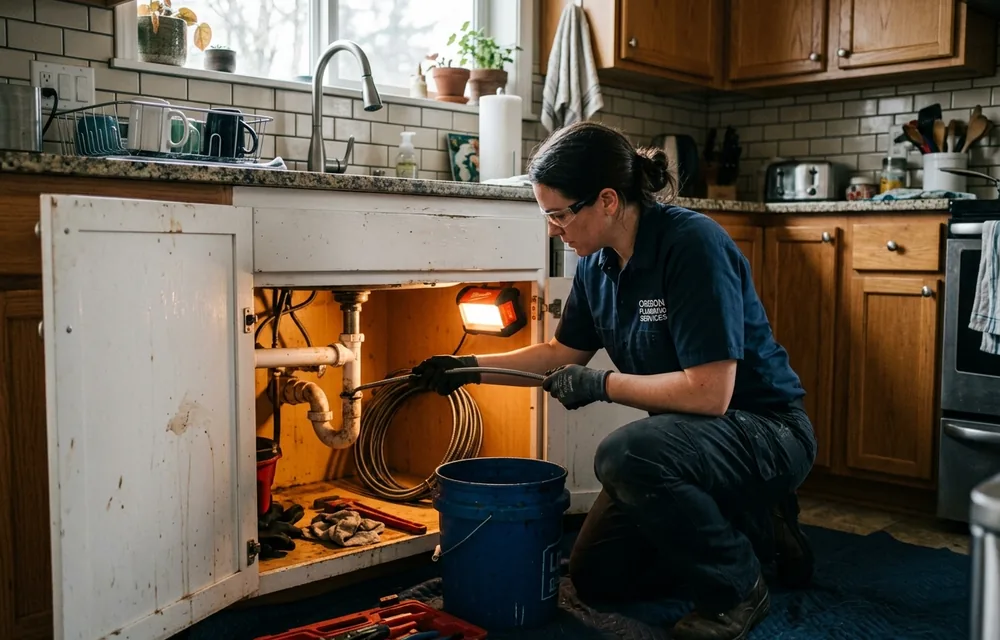
A cable machine — a rooter — drives a rotating steel cable down the line with a cutting head on the end. It is the right tool for a solid obstruction: a root mass, a wad of wipes, a foreign object. It bores a channel through the blockage and restores flow immediately, and it is the cheaper option.
Hydro jetting uses water at 1,500 to 4,000 psi through a reverse-thrust nozzle that pulls itself up the line and scours the pipe wall back to bare material. It is the right tool for a coating: grease, scale, biofilm, fine root hair. A cable through a grease-coated line opens a hole in the middle of the coating and leaves the coating in place, which is precisely why the interval between your clogs keeps getting shorter.
The rule that holds up: first-time blockage, cable it. Third blockage in two years, jet it — because the recurrence itself is the evidence that the line is coated rather than obstructed.
And an important limit. Orangeburg, badly corroded cast iron and cracked clay must never be jetted, because pressure can turn a leak into a collapse. That is why any line old enough to be suspect gets a camera before a jetter, not after. Our jetting vs snaking tool walks through the same decision, including the cases where the honest answer is to spend less.
When a gurgle becomes an emergency
A gurgle is a warning, not a crisis. These are the transitions that change that:
- Water backing up into a shower pan or floor drain when you flush. The main is now blocked enough that waste has nowhere else to go. Stop all water use in the house immediately, including the dishwasher and washing machine.
- Two or more fixtures backing up. Same conclusion, more urgent.
- Sewage on the floor. Keep people and pets out of it, stop using water entirely, and call. Our guide to the first ten minutes of a sewer backup covers what to do while you wait.
- A gurgle that appears during heavy rain in the Willamette Valley. Groundwater infiltrating a cracked lateral raises the water level in the line and can push it past capacity. It usually means a defective pipe rather than a blockage, and it will recur every storm until the defect is fixed.
The reason to act on a gurgle rather than tolerate it is arithmetic. A scheduled cable through a cleanout is a few hundred dollars on a weekday morning. The same line, failed completely, on a Sunday night, with water damage to a finished floor, is an order of magnitude more — and the difference between those two outcomes is usually a couple of weeks of ignoring a noise.
Frequently asked questions
Is a gurgling toilet an emergency?
Not yet, but it is a warning that should not wait. A gurgle means air is being forced through a water seal, which points at a partial main line blockage or a blocked vent. Neither improves on its own. The practical risk is that a partial blockage becomes a total one at the worst possible time — during a holiday, or in the middle of an Oregon rain event when call volume is already high and response times are longest.
Why does my toilet gurgle when the washing machine drains?
Because the washer discharges a large volume very quickly and your drain system cannot move it and the air it displaces at the same time. That is the classic signature of a partial main line restriction: everything seems fine under light use and only fails under load. It is worth acting on, because the same restriction will also fail under a normal flush eventually.
Can I fix a gurgling toilet myself?
Occasionally. If the cause is a blocked vent you can safely reach from the roof, flushing it with a hose may resolve it. Everything else — main line blockages, root intrusion, pipe defects, septic problems — is beyond the reach of homeowner tools, and the two most common DIY responses (repeated plunging and chemical drain cleaner) both make the situation worse rather than better.
Does a gurgling toilet mean my septic tank is full?
It can, and if you are on septic it is one of the earlier signs. Corroborating evidence is soggy ground or unusually green grass over the drain field, slow drains throughout the house rather than at one fixture, and sewage odour outdoors. If the tank is simply full, a pump-out at $400 to $700 resolves it. If the drain field is saturated, that is a much larger problem and continuing to load it makes it permanent.
How long can I leave a gurgling toilet before fixing it?
There is no safe interval, because the failure is not gradual in the way the symptom is. A partial blockage narrows until one ordinary flush exceeds what is left, and that moment is not predictable. What is predictable is the cost difference: a scheduled weekday visit versus an after-hours emergency with water damage. If you are in the Willamette Valley heading into the wet season, deal with it before the rain arrives — that is when marginal lines fail and when everyone else is calling too.
Services mentioned in this guide
Rooter Service & Tree Root Removal
Roots do not break into a healthy pipe.
Drain Cleaning
A single slow sink is a nuisance.
Sewer Camera Inspection
A sewer scope is the cheapest insurance in real estate and the only defensible basis for an excavation quote.
More guides
How to Unclog a Drain Yourself (and When to Stop)
Most single-fixture clogs are genuinely a DIY job. Here is what works, in the order a plumber would try it — and the p…
Sewer Backup: What to Do in the First Ten Minutes
A main line backup gets measurably worse with every gallon of water the household uses. What you do in the first ten m…
Winterizing Plumbing in Oregon: A Regional Checklist
Generic winterizing advice is written for the Midwest and it is either overkill or dangerously inadequate depending on…