The best tankless water heater for an Oregon home in 2026, and how to choose one
The best tankless water heater for an Oregon home is the one sized for February, not for the brochure. Oregon groundwater arrives in the 40s Fahrenheit in winter, and colder east of the Cascades, so the unit has to deliver your peak flow at a rise of roughly 72 to 82 degrees. For a gas unit, ENERGY STAR's current specification requires an efficiency rating of at least 0.95 UEF, which is also a condition of Energy Trust of Oregon's $400 incentive. After that, your gas line and venting decide what it costs to install.
Why this guide does not rank brands
Most "best tankless water heater" lists rank models their authors have never installed or tested in a cold climate. We have not bench-tested units either, so this guide does not pretend to: it gives you the criteria that separate a good choice from a bad one for any brand, and the official lists that let you check a specific model.
Those criteria matter more than the badge. A premium unit that is undersized for an Oregon winter will run out of hot water mid-shower every February; a mid-range unit sized correctly and installed on an adequate gas line will not. The two lists worth using are ENERGY STAR's certified product finder and Energy Trust of Oregon's qualified products list for gas tankless water heaters.
Size it for an Oregon February, not a summer rating
| Region | Winter inlet water | Rise to deliver 120°F |
|---|---|---|
| Oregon Coast | 48°F | 72°F |
| Portland metro | 46°F | 74°F |
| Willamette Valley | 45°F | 75°F |
| Southern Oregon | 44°F | 76°F |
| Central Oregon | 40°F | 80°F |
| Eastern Oregon | 38°F | 82°F |
A tankless unit does not store hot water. It raises cold water by a certain number of degrees at a certain flow, and the harder it has to work on temperature, the less flow it can deliver. That is why the same model that feels generous in August can struggle in February.
The table shows the typical winter inlet temperatures our water heater sizing calculator uses for each region, and the temperature rise needed to deliver 120°F at the tap. The rise a unit has to manage in Oregon is roughly 72°F on the coast and 82°F in Eastern Oregon.
Compare models at a rise close to yours. ENERGY STAR defines a unit's maximum flow rating at a 67°F rise, which is a useful common yardstick, but it is a milder rise than any Oregon region needs in winter, so the real February flow will be lower than that figure. Manufacturer flow tables at different rises are the place to look; the calculator does the arithmetic for your household.
Then size to your peak, not your average: the number of fixtures that realistically run at once. A shower plus a kitchen tap is a very different demand from two showers plus a dishwasher. Undersizing is the most common tankless complaint, and it is the one no amount of money spent on the unit can fix afterwards.
Efficiency: what ENERGY STAR requires in 2026
ENERGY STAR's current residential water heater specification, Version 5.0, took effect on April 18, 2023. For gas-fired tankless (instantaneous) water heaters it requires:
- Uniform Energy Factor (UEF) of 0.95 or higher. UEF is the standard measure of a water heater's overall efficiency.
- Maximum flow of at least 2.8 gallons per minute over a 67°F rise.
- A warranty of at least 6 years on the heat exchanger and 5 years on parts.
In practice, a 0.95 UEF is reached by condensing units, which recover heat from the exhaust. Condensing units produce acidic condensate that needs a drain, and they typically vent through plastic pipe, which can make venting simpler than for an older non-condensing unit. Ask about both at the quote stage.
One forward-looking note in the same specification is worth knowing if you are deciding between gas and electric for the next fifteen to twenty years: the EPA states that it anticipates eventually sunsetting ENERGY STAR criteria for gas water heaters, as it expects gas water heating to become less common and more expensive. That is a statement of direction, not a date, but it is part of the long-term picture.
Qualifying for the Energy Trust incentive
Energy Trust of Oregon pays $400 toward a gas tankless water heater for customers of PGE, Pacific Power, NW Natural, Cascade Natural Gas or Avista. The conditions are specific, and they shape which unit you choose:
- The unit must be ENERGY STAR qualified at the time of purchase and on Energy Trust's qualified products list.
- It must replace an existing gas storage tank water heater.
- The home must have an existing half-inch or three-quarter-inch gas line capable of serving the existing gas appliances plus the tankless unit. A line upgrade between the meter and the unit is acceptable; an upgrade between the street and the meter disqualifies the project unless the utility paid for it.
For comparison, a heat pump water heater replacing an electric tank attracts up to $1,200 from Energy Trust, and the federal tax credit that used to apply to both ended with 2025. Our Oregon water heater rebates guide has every condition.
Gas line and venting: where the price hides
The unit is the visible part of the cost. The gas line is where tankless installations go over budget, and it is the most common and most expensive surprise in a conversion.
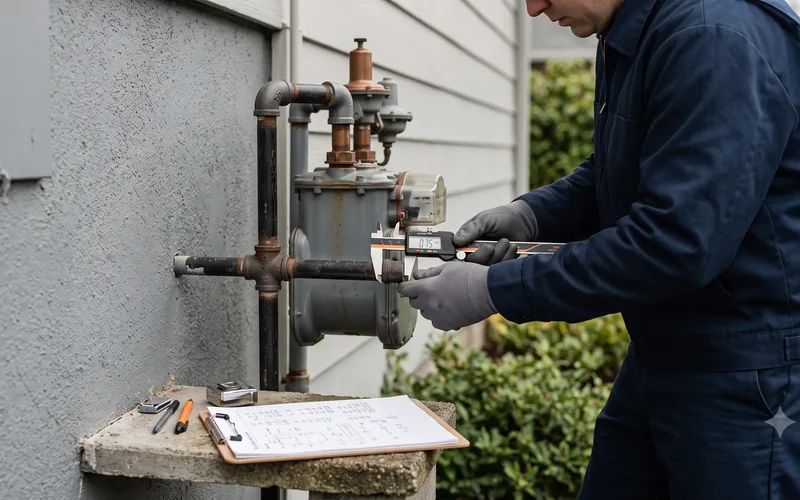
A tankless heater burns a great deal of gas while it runs, far more than the tank it replaces, because it heats water instantly rather than slowly. ENERGY STAR's definition covers gas tankless units up to 200,000 BTU per hour of input. The existing gas line has to carry that on top of the furnace, range and dryer. If it cannot, the choices are a larger line or a smaller unit, and a smaller unit may not meet your February demand.
Have the gas line measured before you choose a model, not after it is on the wall. The size of the line, its length from the meter, and the other appliances on it together decide what the house can support. The tankless installation page explains what a proper assessment covers.
Venting is the second hidden cost. A tankless unit usually cannot reuse a tank's old flue; it needs its own vent run to the outside, and where that run goes, through a wall or up through the roof, changes the labour considerably.
Electric tankless in an Oregon winter
Electric tankless units are small and simple to vent, which makes them attractive, but whole-house electric tankless is a hard fit for Oregon winters. Delivering a 75 to 82 degree rise at the flow a household needs takes a very large electrical load, often more than an existing panel can supply without an upgrade.
Electric tankless units make most sense as point-of-use heaters, serving a single sink or a distant bathroom, rather than as a whole-house replacement.
If you are on electric and want to cut water heating costs, a heat pump water heater is usually the stronger 2026 choice: Energy Trust pays up to $1,200 toward one that replaces an electric tank, and EWEB pays $1,100 in Eugene. It needs a garage or basement with air volume rather than a closet. Our 2026 replacement cost guide compares the three types.
How long a tankless water heater lasts in Oregon, and what it needs
A tankless unit commonly lasts fifteen to twenty years, against eight to twelve for a tank, and that longer life is a real part of its value. But it depends on one piece of maintenance that tank owners are used to skipping: descaling.
Minerals in the water deposit as scale inside the heat exchanger, the narrow passages where the water is heated. As scale builds, the unit works harder, flow drops and, eventually, it shuts itself down or fails early. How fast that happens depends on your water. Bend, Redmond, Klamath Falls and the Ontario area run considerably harder water than the Willamette Valley, so units there need descaling more often than the same model in Portland or Eugene. Our hard water guide covers the regional picture.
Two things at installation make that maintenance easy. Isolation valves on the water connections let the unit be flushed without draining the house, and a good installer fits them as standard. And the unit should be installed where someone can actually reach it: a tankless heater tucked above a ceiling or behind a fixed panel is one that will not get descaled.
Ask for the manufacturer's recommended descaling interval for your water hardness when you buy, and put it in the calendar. It is the cheapest insurance on the most expensive part of the unit.
A checklist before you buy a tankless water heater
Work out your peak demand
Count the fixtures that realistically run at the same time, and run the numbers through the sizing calculator for your region.
Check the flow at your winter rise
Use the manufacturer's flow table at a rise close to 72°F to 82°F, not the headline maximum.
Confirm ENERGY STAR and the qualified list
A UEF of 0.95 or higher, and the exact model on Energy Trust's list if you want the $400.
Have the gas line assessed
Before choosing a model. Line size, length and the other gas appliances decide what the house can support.
Plan the vent and condensate drain
Know where the vent will exit and where the condensate will go before the unit is ordered.
Get it permitted and inspected
A water heater replacement has to meet the code items Oregon requires at replacement, such as combustion air for gas units. The inspection is where they are checked; the replacement cost guide lists them.
Frequently asked questions
What size tankless water heater do I need in Oregon?
Size it to your peak simultaneous demand at a winter temperature rise of about 72°F on the coast to 82°F in Eastern Oregon, because groundwater arrives in the 40s or colder in winter. A unit that looks large on a summer rating can deliver far less flow in February. The sizing calculator on this site works it out for your region.
What makes a tankless water heater ENERGY STAR certified?
Under ENERGY STAR Version 5.0, in effect since April 18, 2023, a gas tankless unit needs a Uniform Energy Factor of 0.95 or higher, a maximum flow of at least 2.8 gallons per minute over a 67°F rise, and warranties of at least 6 years on the heat exchanger and 5 years on parts.
Is there a rebate for a tankless water heater in Oregon in 2026?
Energy Trust of Oregon pays $400 for an ENERGY STAR gas tankless water heater on its qualified list that replaces an existing gas tank, in a home with an adequate existing gas line. The federal tax credit ended with 2025. Confirm the current amount before buying.
Is an electric tankless water heater a good idea in Oregon?
For a whole house, usually not. Oregon's cold winter inlet water means a large temperature rise, and delivering it electrically takes a very large electrical load that many panels cannot supply. Electric tankless works well at a single sink. For a whole house on electric, a heat pump water heater is usually the better choice.
Why does my new tankless water heater run cold in winter?
Almost always because it is undersized for the winter temperature rise or the gas line cannot supply its full input. In an Oregon winter the unit has to raise water by 72°F to 82°F, and at that rise its flow drops. A gas pressure check and a sizing review find which one it is.
Services mentioned in this guide
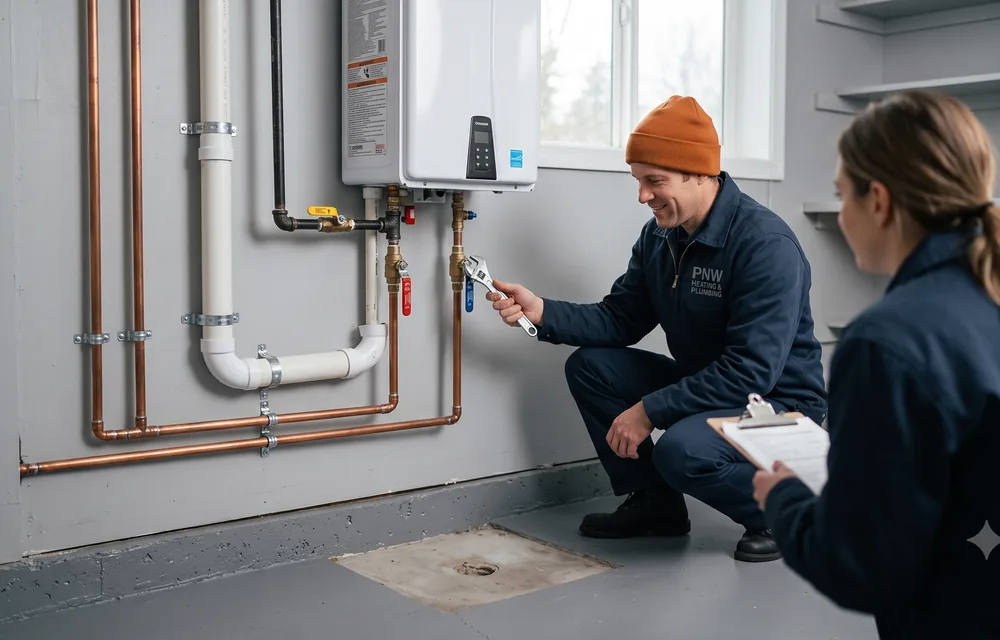
Tankless Water Heater Installation
Tankless is a genuinely better appliance for the right house and a frustrating, expensive mistake in the wrong one.
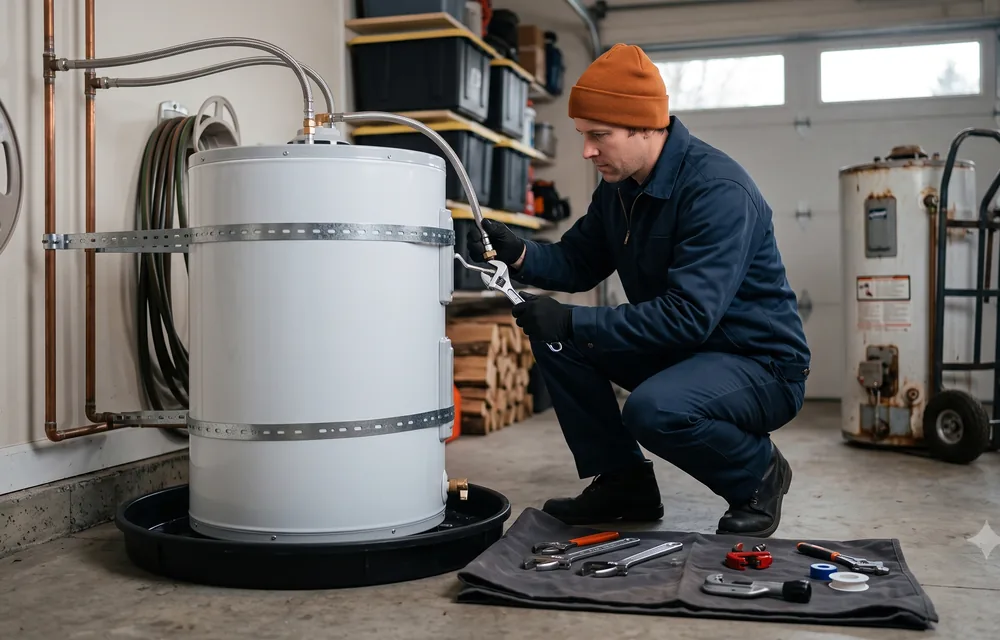
Water Heater Repair & Replacement
Most water heater calls split cleanly into two groups: a $200 part on a tank worth keeping, and a tank that has already failed and is quietly ruining the floor.
More guides
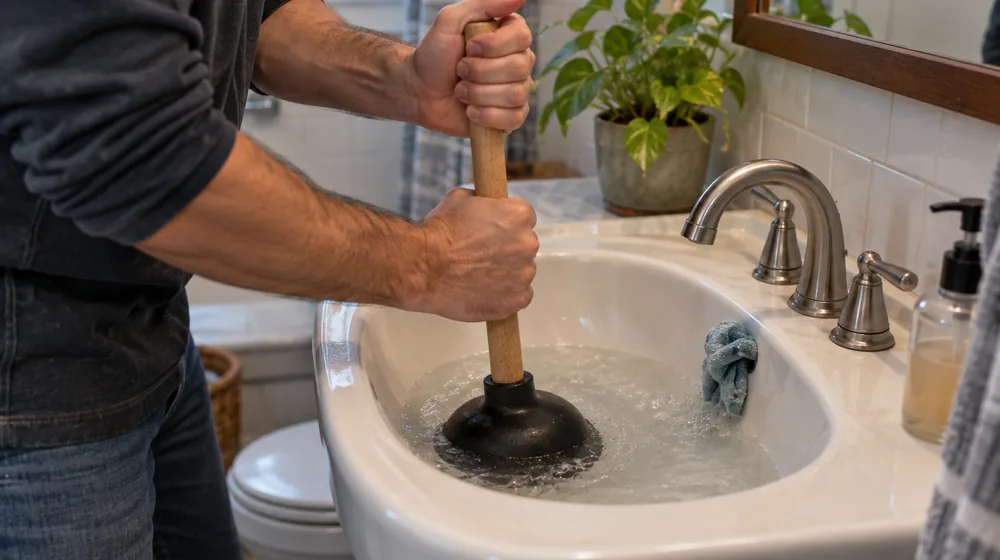
How to Unclog a Drain Yourself (and When to Stop)
Most single-fixture clogs are genuinely a DIY job. Here is what works, in the order a plumber would try it — and the p…
Sewer Backup: What to Do in the First Ten Minutes
A main line backup gets measurably worse with every gallon of water the household uses. What you do in the first ten m…
Winterize Oregon Plumbing: 2026–27 Winter Checklist
For winter 2026–27, NOAA forecasts a very strong El Niño, which usually tilts Oregon toward a warmer, drier winter, bu…